
India’s GCC Boom Runs on Trusted Talent & That’s Why Exam Integrity Matters
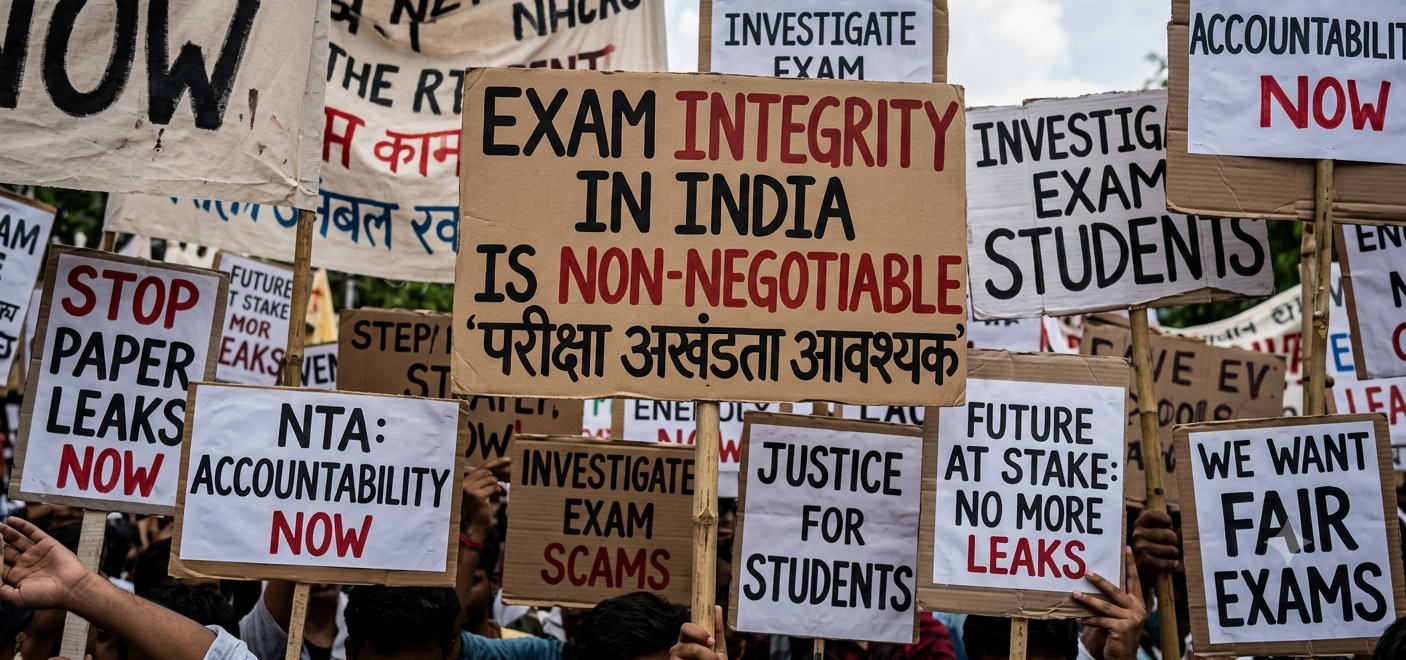
As GCCs deepen partnerships with universities and expand campus hiring, the credibility of India's education ecosystem becomes increasingly important to sustaining long-term investment.


What does the NEET paper leak have to do with India’s Global Capability Centre (GCC) boom? At first glance, very little. GCCs don’t hire doctors. But they do depend on the same thing that every competitive examination is meant to protect: trust in India’s ability to identify and certify talent. India’s GCC story is built on a simple promise to multinational companies: the world’s deepest pool of skilled talent. But talent alone has never been India’s real competitive advantage. Trust has.
Every year, global companies hire thousands of graduates from Indian campuses with the confidence that the country’s education and examination systems have already done the first layer of validation for them. Degrees, entrance examinations and university rankings act as signals of competence long before a recruiter administers a coding test or technical interview.
That is why the recent NEET-UG paper leak controversy deserves attention far beyond the education sector. Not because it will derail India’s GCC industry overnight- it won’t- but because it raises a larger question: what happens when confidence in the institutions that certify talent begins to erode?
The answer matters for an industry that expects to become one of India’s largest engines of employment over the next decade.
India’s economic powerhouse
Few sectors have transformed India’s global economic standing as dramatically and as efficiently as Global Capability Centres.
Once viewed as low-cost back offices, GCCs have evolved into strategic hubs for software engineering, artificial intelligence, cybersecurity, finance, product development and global operations. According to the latest NASSCOM–Zinnov GCC report, India now hosts 2,117 Global Capability Centres, employing 2.36 million professionals and generating US$98.4 billion in annual revenue, nearly reaching projections that were once expected only by 2030.
Those numbers are impressive. But they are also built on an assumption that is rarely discussed.
Global companies don’t simply invest in India’s labour market. They invest in India’s talent validation system.
Trust is the invisible infrastructure
Recruiters rarely meet graduates for the first time without prior assumptions.
An IIT degree, a top NIT, a leading private engineering college or a competitive entrance examination already tells employers something about the candidate sitting across the table. These credentials are not guarantees of excellence, but they dramatically reduce uncertainty.
That efficiency is invaluable at scale.
The NASSCOM–Zinnov India GCC Landscape Report identifies talent transformation and ecosystem partnerships as central to the sector’s evolution, highlighting how GCCs are increasingly collaborating with universities on campus hiring, curriculum development, skilling initiatives and research to build future-ready talent pipelines, rather than relying solely on lateral hiring.
Institutional trust makes these pipelines possible. Without it, every employer has to spend more time and money proving what the education system was expected to establish in the first place.
Why NEET matters—even if GCCs don’t hire doctors
This is where the NEET controversy becomes relevant.
The issue is not that medical entrance examinations affect engineering recruitment. They largely do not.
The real issue is what repeated examination controversies signal about institutional credibility.
The 2026 NEET examination had to be reconducted after investigators found significant overlaps between a leaked “guess paper” and the actual examination, echoing the controversy that engulfed the exam in 2024. The immediate victims are medical aspirants. The broader casualty is public confidence in the systems that determine merit.
Trust, once questioned, rarely remains confined to a single examination. It inevitably raises wider questions: Can credentials be taken at face value? How much faith should employers place in institutional certification? When does verification become more valuable than qualification?
These questions are not unique to India. Around the world, employers are already beginning to ask them.
Employers are already changing how they hire
The shift towards skills-first hiring was underway long before the NEET controversy.
The World Economic Forum’s Future of Jobs Report 2025 estimates that almost 40% of today’s core workforce skills will change by 2030, prompting organisations to place greater emphasis on demonstrable capability rather than credentials alone.
The same trend is visible inside India’s GCC ecosystem.
According to the EY GCC Pulse Survey 2025, companies are increasingly prioritising specialised skills, continuous reskilling and internal capability development over assuming graduates are job-ready from day one.
Coding assessments, Portfolio reviews, Hackathons, Simulation exercises, AI-assisted technical interviews – these are no longer recruitment innovations; they are becoming recruitment necessities.
Verification comes at a price
It would be tempting to conclude that stronger hiring assessments make educational credentials less important – they don’t.
They simply shift the burden of proof from universities to employers.
The OECD’s work on skills-first hiring cautions that organisations replacing traditional credentials must build equally robust assessment frameworks. Those frameworks require technology, standardisation, recruiter training and significant investment.
In other words, every additional coding test, technical assessment or validation exercise represents a cost that employers would rather not incur.
The more trust weakens, the more verification expands.
The real lesson for India’s GCC ambitions
The NEET controversy is not a GCC crisis. It is something subtler and potentially more important.
It is a reminder that India’s position as the world’s preferred GCC destination rests not only on producing millions of graduates, but on convincing global employers that those graduates have emerged from systems whose outcomes can be trusted.
Infrastructure attracts investment, policy enables investment, and Talent sustains investment.
But trusted talent is what gives India its competitive edge.
As India competes with countries such as Vietnam, Poland, the Philippines and Mexico for the next wave of Global Capability Centres, examination integrity should no longer be viewed solely as an education policy issue.
It is an economic competitiveness issue, because the world’s leading companies don’t just outsource work to India; they outsource confidence in India’s ability to identify, nurture and certify talent.
And confidence, once lost, is always harder to rebuild than capability itself.
The author writes on technology, business strategy, and policy developments shaping India’s GCC ecosystem. The views expressed are personal.