
Bengaluru’s GCC Crown is Stuck in Traffic
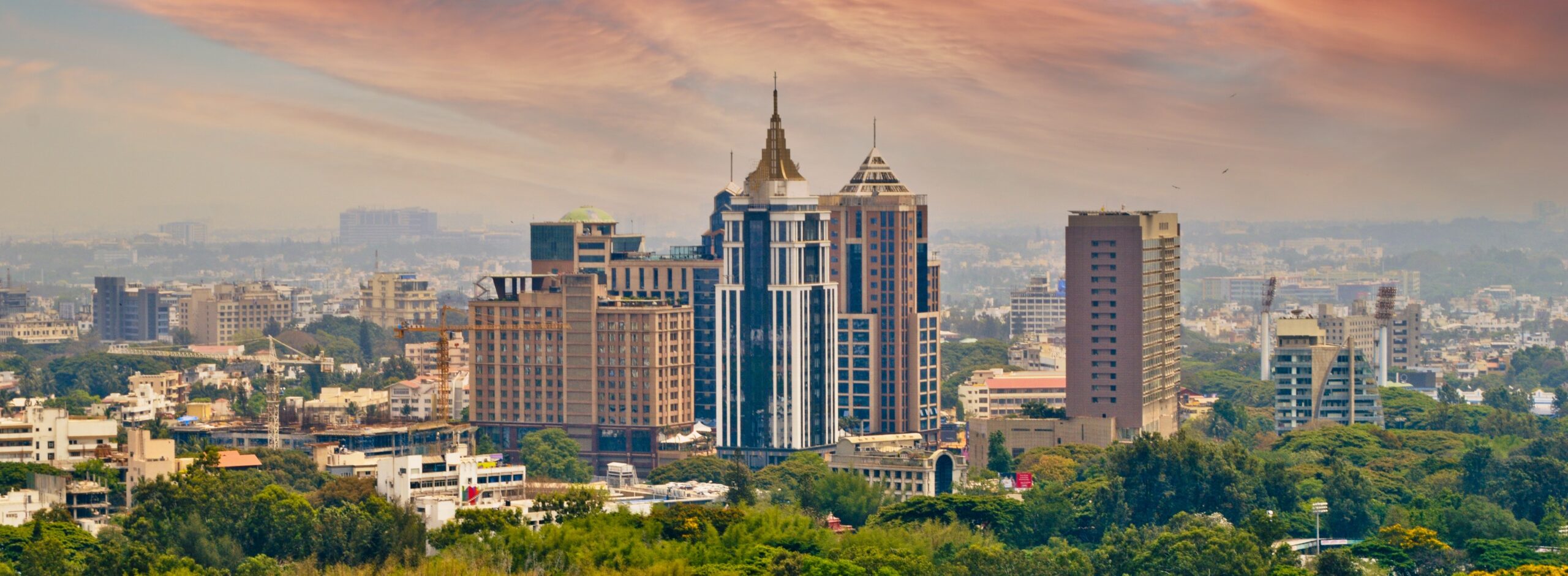
Hyderabad is gaining new GCCs, while Bengaluru’s infrastructure challenges test its ability to retain the lead.


In mid-August, the companies on Bengaluru’s Outer Ring Road did something unusual: they said no to the government. The ORR is the tech corridor that anchors much of the city’s Global Capability Centre (GCC) economy, and officials had planned a ₹450-crore makeover of its 17-km stretch, including concrete white-topping. They had also floated a way to manage the chaos it would cause: let employees work from home.
The Outer Ring Road Companies Association (ORRCA), which represents more than 500 firms, wrote back that “Work From Home cannot be a substitute for effective infrastructure planning and traffic management.”
That sentence belongs above every desk in Vidhana Soudha. It is also the most honest summary of where Bengaluru’s GCC story stands in 2026.
The commute is now the competition
For two decades, global companies came to Bengaluru for talent at a price, but today’s GCCs want more than that. They are hiring engineering, AI, and product teams that own global mandates. Those people have options, and in Bengaluru they spend 168 hours a year stuck in rush-hour traffic, which adds up to seven full days. TomTom’s latest index ranks Bengaluru the second most congested city in the world.
On scale, Bengaluru still leads. Zinnov counts more than 880 centres here, along with the country’s deepest engineering and AI talent base. But momentum has shifted. As of 2025, Hyderabad attracted 40% of all new greenfield GCCs set up in India over three years, according to staffing firm Xpheno, whereas Bengaluru’s share was 33%.
Karnataka has read those numbers. Its GCC strategy has pivoted from chasing new centres to helping existing ones scale. That is sensible. But it only works if people inside those centres are willing to stay, and the ORR commute doesn’t push them the other way every working day.
A metro that keeps moving its deadlines
The one fix everyone agrees on is the metro. The Blue Line will run the length of the ORR tech corridor and on to the airport. In August, Greater Bengaluru Development Minister Krishna Byre Gowda announced it will be fully operational only by March 2028, three months later than the previous target. The ORR stretch is moving towards trial runs, but commercial services are still months away.
Meanwhile, the white-topping is set to begin in October and finish by January 2027. That means digging up the carriageway while the metro above it is still unfinished, which is exactly the overlap ORRCA warned against. On a corridor this crowded, the order of the works matters as much as the money.
To his credit, Byre Gowda has made his deadlines public and taken ownership of them. “Now I have to find a way of delivering,” he said in July. GCC leaders will hold him to it. Their site-selection spreadsheets already track those dates.
The tunnel question
Chief Minister D K Shivakumar is pushing something bigger: a 16.75-km twin-tube tunnel road from Hebbal to Silk Board. Pitching it to entrepreneurs earlier this month, he asked: “How can you do without a tunnel?“
There are fair answers. The lowest bid, from Adani Enterprises, came in at ₹22,267 crore, well above the government’s own estimate of ₹17,698 crore. After public protests, the CM has also hinted at a new alignment that avoids Lalbagh. And critics have pointed out that a metro line can carry up to 25,000 passengers per hour in each direction, while the tunnel’s capacity is about 1,600 cars.
For a GCC workforce measured in lakhs, that arithmetic is hard to ignore. A tunnel moves cars. A metro moves headcount.
Who answers for the ORR?
There is also a governance gap. The BBMP is gone. Bengaluru is now run as five city corporations under the Greater Bengaluru Authority, and the city has had no elected council since 2020. The Supreme Court has set December 31 as the final deadline for civic polls. Shivakumar has promised: “I will see that by this December all the elections will be completed.”
Until that happens, a GCC on the ORR with a flooded underpass or a broken footpath has no corporator to call.
Bidadi: hedge or escape hatch?
Then there is the new city. The Greater Bengaluru Integrated Township near Bidadi is pitched as India’s first AI city. It has moved to final land notifications despite more than 15 months of farmer protests. Last year, the protesters asked a blunt question: “They can’t manage Bengaluru, how can they build an AI city in Bidadi?“
It is a warning worth heeding. A second city could attract the next wave of GCCs, but only if it is built around transit from day one. And it cannot become an escape from the problems of the first city. Today’s GCCs sit on the ORR, in Whitefield, around Hebbal and in Electronic City. That is where Bengaluru’s lead will be kept or lost.
What would change the story?
Three things would help. First, finish the metro before tearing up the road beneath it. Second, give industry bodies like ORRCA a formal role in deciding the sequence of works, not just a seat at a town hall. Third, publish one integrated calendar covering metro, roads and tunnels, so a GCC head in Seattle or Frankfurt can see what 2027 will actually look like.
Bengaluru will not lose its GCC crown in one bad quarter. It will lose it one deferred expansion at a time, whenever a global CFO weighing Bengaluru against Hyderabad remembers the hour she spent crawling past Silk Board on her last site visit.
The companies on the ORR have already said it plainly: work from home is not an infrastructure plan. The city needs to stop treating it like one.
The author writes on technology, business strategy, and policy developments shaping India’s GCC ecosystem. The views expressed are personal.