

Tag: GCC India

  • TVS Motor to Invest Rs 2,000 crore in Karnataka, sets up GCC

    TVS Motor to Invest Rs 2,000 crore in Karnataka, sets up GCC

    New GCC will bring together engineers, designers, innovators, and AI & ML experts to help define the future of mobility. 


    GCC Hub Team

    NEW DELHI: TVS Motor Company, one of India’s leading two-wheeler manufacturers, has signed a Memorandum of Understanding (MoU) with the Karnataka government to invest Rs 2,000 crore over five years, marking a significant expansion of its operations in the state.

    The investment will be used to set up a global capability centre (GCC) in Karnataka, which will serve as a hub for research and development, innovation, and engineering. The GCC will be the birthplace of next-generation bikes, according to TVS Motor’s Managing Director, Sudarshan Venu.

    The centre will bring together engineers, designers, innovators, artificial intelligence (AI), and machine learning (ML) experts, who will define the future of mobility. The investment will also be used to set up a new test track and office infrastructure, further enhancing TVS Motor’s capabilities in the state.

    TVS Motor’s Mysuru facility, which employs over 3,500 people, has an annual production capacity of 15 lakh vehicles. The company aims to double its exports and overall revenues from the Mysuru operations, with export revenues currently exceeding Rs 1,200 crore.

    The investment is a significant boost to Karnataka’s efforts to attract investments and promote industrial growth. The state government launched its new Industrial Policy 2025-30, which aims to achieve a 12% annual growth rate in manufacturing, attract Rs 7.5 lakh crore in investments, and generate 20 lakh jobs by 2030.

    The state also launched an AI-powered single window system in partnership with Microsoft to fast-track industrial approvals and improve business efficiency. The move is expected to make Karnataka an attractive destination for investors and promote ease of doing business.

    TVS Motor’s investment is the latest in a series of announcements made at the Invest Karnataka 2025 summit, which aims to attract investments and promote industrial growth in the state. Chipmaker Lam Research announced an investment of Rs 10,000 crore, while other companies also made significant investment commitments.

  • Madhya Pradesh Eyes GCCs to Revamp Economy

    Madhya Pradesh Eyes GCCs to Revamp Economy

    Madhya Pradesh launches India’s first GCC policy to attract multinational corporations, decentralize economic growth, and establish Tier-2 cities as global innovation hubs.


    In a move that signals India’s growing ambition in the global services sector, Madhya Pradesh has become the first state in the country to unveil a dedicated policy for Global Capability Centres (GCCs). The initiative is designed to position the central Indian state as a hub for multinational corporations (MNCs) looking to set up offshore centres for high-value research, product development, and digital transformation.

    Historically, India’s IT sector has been driven by outsourcing giants headquartered in Bengaluru, Hyderabad, and Pune. GCCs, on the other hand, represent a newer breed of corporate investment, where global firms establish in-house technology and innovation centres rather than relying on third-party vendors. These centres handle critical business functions ranging from AI-driven analytics to financial services and cybersecurity, often influencing strategic decisions at headquarters.

    Madhya Pradesh’s decision to enter this space is not accidental. The state’s economic planners recognise that while India dominates the GCC market—accounting for over 50% of global GCCs—the industry remains concentrated in a few metropolitan hubs. By attracting investment into Tier-2 cities such as Indore and Bhopal, policymakers hope to decentralise economic growth, reduce congestion in established IT cities, and create new urban knowledge economies.

    The policy is generous with incentives. Companies setting up GCCs in the state will be eligible for a capital expenditure subsidy of up to 40%, with a cap of ₹30 crore ($3.6 million). Additional benefits include rent assistance, payroll subsidies, and financial support for R&D and patent filings. The government also aims to make the investment process frictionless, with a “No Query Portal” that promises a streamlined, single-window clearance system—an important step in a country where regulatory red tape is often cited as an investment deterrent.

    Beyond incentives, Madhya Pradesh is making a play for long-term viability by investing in talent and infrastructure. The state boasts five Special Economic Zones (SEZs) and 15 IT parks, along with a network of over 300 engineering colleges producing more than 50,000 graduates annually. However, the real challenge will be convincing top-tier talent, which currently gravitates towards cities like Bengaluru and Gurugram, to relocate to emerging hubs in central India.

    India’s GCC sector has been on a steep growth trajectory, with over 1,950 centres currently operating in the country. These centres employ approximately 1.9 million professionals and contribute an estimated $60 billion to the economy. The national government has recognised the strategic importance of the sector, setting a target of growing India’s GCC market to $110 billion by 2030. Madhya Pradesh’s policy fits neatly within this broader ambition.

    However, the state faces stiff competition. Karnataka recently announced a GCC policy aiming to double the number of centres operating in Bengaluru by 2029. Gujarat, meanwhile, is promoting its GIFT City as an alternative for financial services GCCs, offering tax breaks and regulatory advantages.

    The success of Madhya Pradesh’s GCC policy will hinge on execution. While its incentives are competitive, states like Telangana and Maharashtra already offer similar benefits. The real differentiator will be how quickly and effectively the state can operationalise its promises.

    If Madhya Pradesh succeeds, it could offer a template for other states looking to enter the high-value end of the global services market. If it falters, the policy will be yet another reminder that India’s IT industry, for all its scale, remains stubbornly tied to a few dominant cities.

    For now, Madhya Pradesh is making a bold bet that it can reshape India’s economic geography. Whether global corporations follow its lead remains to be seen.

  • Gujarat’s GCC Policy Aims for ₹10,000 Crore Investment

    Gujarat’s GCC Policy Aims for ₹10,000 Crore Investment

    Gujarat Chief Minister Bhupendra Patel launched the policy on February 11 in the presence of GIFT City Managing Director Shri Tapan Ray, Director of NITI Aayog Shri Debjani Ghosh, Principal Secretary of the Department of Science and Technology Smt. Mona Khandhar, and prominent entrepreneurs. 


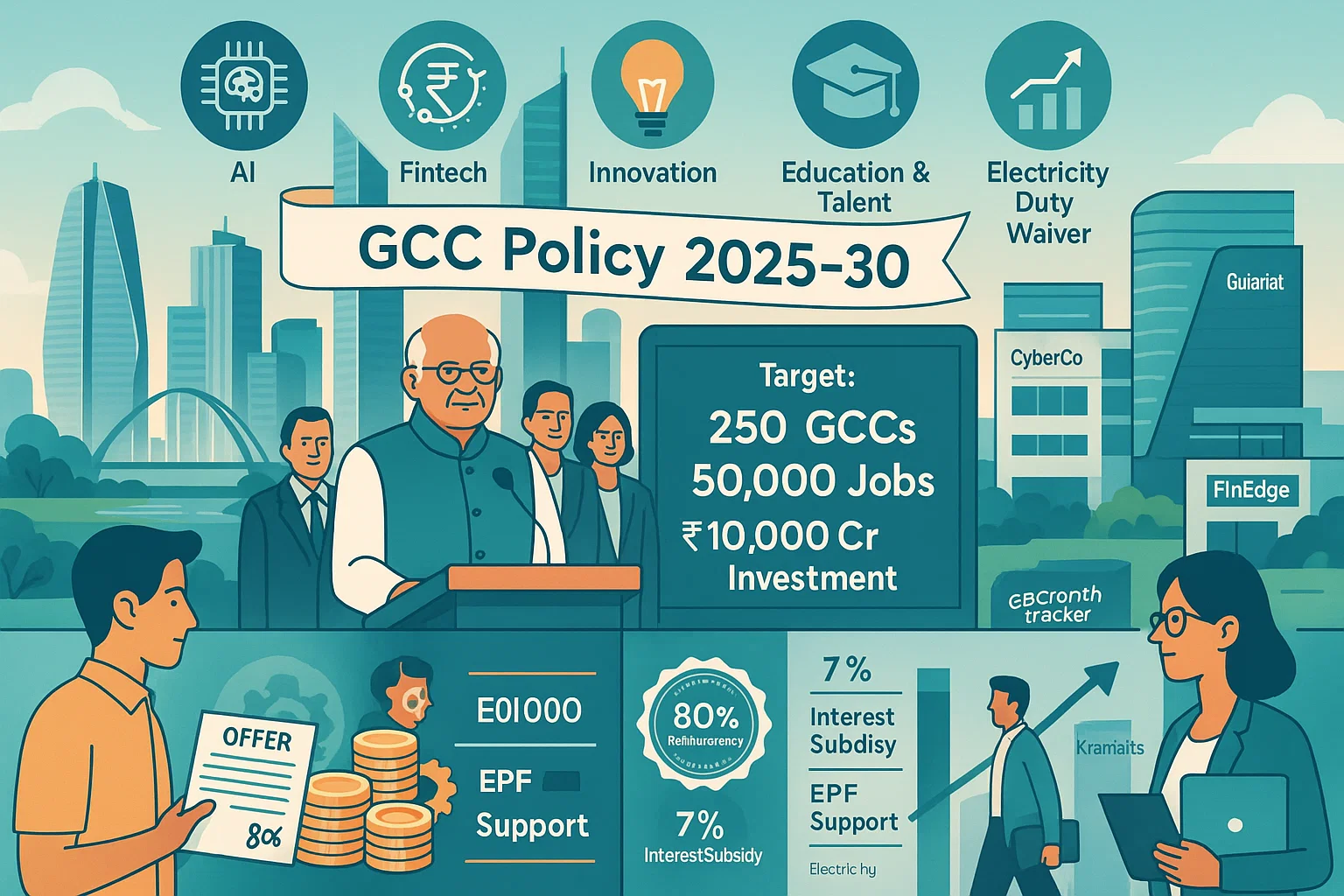
    Gujarat has launched an aggressive Global Capability Centre (GCC) Policy 2025-30, aiming to establish itself as a hub for global companies looking to set up captive units in India. 

    The policy, unveiled by Chief Minister Bhupendra Patel at GIFT City, targets 250 new facilities, 50,000 jobs, and Rs 10,000 crore in investments.

    Gujarat’s GCC policy offers a slew of incentives to attract companies, including capital expenditure support of up to Rs 200 crore and operational expenditure assistance of up to Rs 40 crore. To encourage local hiring, the government will provide a one-time reimbursement covering 50% of one month’s Cost-to-Company (CTC) for newly recruited employees.

    Gujarat Chief Minister Bhupendra Patel launched the policy on February 11 in the presence of GIFT City Managing Director Shri Tapan Ray, Director of NITI Aayog Shri DebjaniGhosh, Principal Secretary of the Department of Science and Technology Smt. Mona Khandhar, and prominent entrepreneurs.

    The policy also includes a 7% interest subsidy on term loans, full reimbursement of electricity duty, and support for employer contributions to the Employees’ Provident Fund (EPF). Companies pursuing quality certifications will be eligible for financial assistance, with the government covering up to 80% of certification costs.

    Gujarat’s move follows Karnataka’s GCC Policy, launched last year, which targets 500 new GCCs by 2029, creating 3.5 lakh new jobs and generating an economic output of $50 billion. GCCs have seen a historic rise in India, providing services in operation, product development, and innovation, and are expected to contribute 3.5% of India’s GDP by 2030.

    The focus on GCCs was also highlighted in the Union Budget 2025-26, with Finance Minister Nirmala Sitharaman announcing a national framework to guide states in promoting GCCs. Experts emphasize the need for cooperation between stakeholders to ensure the policy’s long-term success.

    Tapan Ray, MD and Group CEO, GIFT City, welcomed the policy, saying, “GIFT City is emerging as a prime destination for GCCs, with its integrated ecosystem, strategic initiatives in fintech, Artificial Intelligence, and higher education, ensuring that GCCs have the right resources to thrive.