
Tag: GCC India

  • Sailaja Josyula is Global Head of GCC Services at Cognizant

    Sailaja Josyula is Global Head of GCC Services at Cognizant

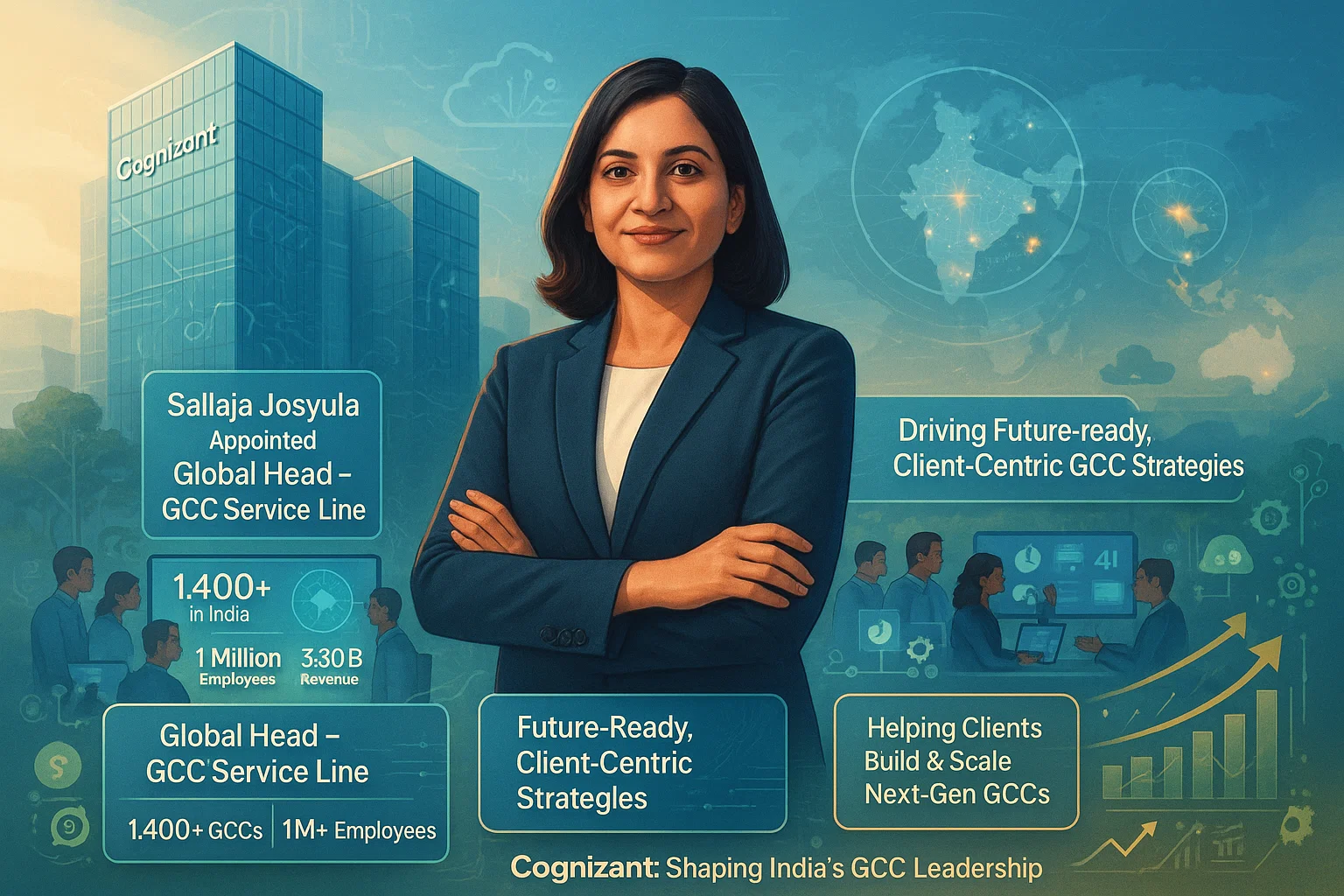
    Cognizant, a leading provider of information technology, consulting, and business process outsourcing services, has appointed Sailaja Josyula as the new Global Head of its Global Capability Center (GCC) Service Line.


    Based in Hyderabad, Josyula will lead the definition and execution of Cognizant’s global GCC strategy, working closely with the leadership team to ensure it is future-ready and client-centric.

    Global Capability Centers (GCCs) are centralized hubs that provide critical business functions, such as finance, human resources, and IT services, to multinational corporations. India has emerged as a preferred destination for GCCs, with over 1,400 centers operating in the country, employing over 1 million people, and generating revenues of over $30 billion.

    Cognizant’s GCC Service Line helps clients set up and manage GCCs, leveraging its expertise in digital transformation, cloud, data analytics, and artificial intelligence.

    Josyula returns to Cognizant after a brief stint at EY. She previously held multiple leadership positions at Cognizant, including Center Head of Hyderabad and Global Head of BFSI Operations Delivery.

    “Sailaja is a strong and experienced leader who truly understands our business, our clients, and our team,” said Surya Gummadi, President, Cognizant Americas, in a LinkedIn post. “Her return to Cognizant is a big milestone as we look to seize the GCC opportunity.”

    In her new role, Josyula will establish and lead a cross-functional team to help clients build and scale next-generation GCCs, ensuring seamless setup and delivery. Her leadership is expected to play a pivotal role in deepening Cognizant’s expertise in this high-growth area and delivering long-term value to clients through innovation, agility, and operational excellence, a press release said.

  • Cognizant Appoints Sailaja Josyula as Global Head of GCC Service Line

    Cognizant Appoints Sailaja Josyula as Global Head of GCC Service Line

    GCC Hub Team

    Cognizant, a leading provider of information technology, consulting, and business process outsourcing services, has appointed Sailaja Josyula as the new Global Head of its Global Capability Center (GCC) Service Line.

    Based in Hyderabad, Josyula will lead the definition and execution of Cognizant’s global GCC strategy, working closely with the leadership team to ensure it is future-ready and client-centric.

    Global Capability Centers (GCCs) are centralized hubs that provide critical business functions, such as finance, human resources, and IT services, to multinational corporations. India has emerged as a preferred destination for GCCs, with over 1,400 centers operating in the country, employing over 1 million people, and generating revenues of over $30 billion.

    Cognizant’s GCC Service Line helps clients set up and manage GCCs, leveraging its expertise in digital transformation, cloud, data analytics, and artificial intelligence.

    Josyula returns to Cognizant after a brief stint at EY. She previously held multiple leadership positions at Cognizant, including Center Head of Hyderabad and Global Head of BFSI Operations Delivery.

    “Sailaja is a strong and experienced leader who truly understands our business, our clients, and our team,” said Surya Gummadi, President, Cognizant Americas, in a LinkedIn post. “Her return to Cognizant is a big milestone as we look to seize the GCC opportunity.”

    In her new role, Josyula will establish and lead a cross-functional team to help clients build and scale next-generation GCCs, ensuring seamless setup and delivery. Her leadership is expected to play a pivotal role in deepening Cognizant’s expertise in this high-growth area and delivering long-term value to clients through innovation, agility, and operational excellence, a press release said.

  • Vanguard to Launch GCC in Hyderabad, Creating 2,300 Jobs

    Vanguard to Launch GCC in Hyderabad, Creating 2,300 Jobs

    Vanguard, the world’s largest mutual fund manager, is setting up a Global Capability Center (GCC) in Hyderabad, creating 2,300 jobs over the next four years.


    The company, which manages $10 trillion in global assets and serves over 50 million investors, will formally open its Hyderabad office later this year. The GCC will serve as an innovation hub, supporting Vanguard’s IT mission and goals, driving AI strategy, and unlocking the potential of data and analytics.

    According to a government statement, Vanguard’s CEO Salim Ramji met with Telangana Chief Minister A Revanth Reddy and top officials to finalize the plans. The company will immediately begin hiring engineers with expertise in artificial intelligence, data analytics, and mobile engineering.

    Vanguard’s move is the latest in a series of investments by global companies in India’s GCC sector. The country’s talent pool, favourable business environment, and government incentives have made it an attractive destination for companies looking to set up innovation hubs and drive digital transformation.

    The Hindu Business Line reported that Vanguard’s Hyderabad office will become a key hub for the company’s global operations, supporting its mobile-first initiatives and driving innovation in the financial services sector.

    This development is expected to further boost India’s reputation as a hub for GCCs, with companies like Google, Amazon, and Microsoft already having a significant presence in the country.

  • Episode 1: GCC Giants Move In

    From Vanguard’s new GCC in Hyderabad to Cognizant’s leadership appointment and Embassy Group’s innovative platform, we bring you the latest news and trends shaping the future of Global Capability Centers (GCCs) in this episode. Our podcast explores the latest trends, updates, and expert analysis to help you navigate the evolving GCC ecosystem. Tune in.

  • India’s IT Talent War Intensifies as GCCs Target Tech Firms

    India’s IT Talent War Intensifies as GCCs Target Tech Firms

    Global Capability Centres are aggressively poaching top IT talent, disrupting India’s outsourcing giants and reshaping the country’s technology job market and innovation landscape.


    For decades, India’s IT services giants have built billion-dollar businesses by providing outsourced talent to multinational corporations. Now, those same corporations are cutting out the middleman. Global Capability Centres (GCCs)—in-house technology hubs set up by multinational firms—are aggressively poaching talent from India’s largest IT services companies, reshaping the industry’s talent dynamics and threatening the dominance of outsourcing giants like Tata Consultancy Services and Infosys.

    The numbers illustrate this shift. Nearly half of all employees in Indian GCCs today have been recruited directly from IT services firms, up from just 35% a year ago. With higher salaries, better career trajectories, and greater exposure to advanced technologies, GCCs are emerging as the new employers of choice for India’s best tech minds.

    Originally established as cost-saving offshore centres for business processes, GCCs have evolved into mission-critical hubs for AI research, cloud computing, cybersecurity, and product development. Companies that once relied on external IT vendors now prefer to develop proprietary software and analytics in-house, reducing dependency on third-party firms.

    This transformation is making GCCs an attractive destination for skilled professionals. Employees working in AI, data science, and cybersecurity roles at GCCs command salaries 20-30% higher than their counterparts in IT services firms. The shift is not limited to engineers—senior executives are also making the move. Over 100 vice presidents and senior leaders from top IT firms have transitioned to GCCs in the past year alone, lured by the prospect of driving global technology strategies rather than simply executing outsourced projects.

    The GCC boom is also reshaping India’s IT geography. While Bengaluru and Hyderabad remain dominant, multinational firms are now expanding their capability centres to second-tier cities such as Coimbatore, Jaipur, and Indore. These cities offer a lower cost of living, reduced attrition rates, and access to an emerging talent pool trained in India’s engineering colleges.

    Companies are also rethinking their recruitment pipelines. GCCs are increasingly hiring from specialized training academies and finishing schools, a strategy that has doubled in adoption over the past two years. Until recently, such hires accounted for just 5% of the workforce at GCCs—today, that figure is nearing 10%, with some experts predicting it could rise to 20% in the coming years.

    For India’s IT outsourcing industry, the rise of GCCs presents an existential challenge. While IT firms still dominate large-scale technology implementation projects, their high-end engineering and consulting talent is increasingly being absorbed into in-house teams at multinational corporations.

    To stay relevant, IT service providers are repositioning themselves. Some are offering co-development partnerships, where GCCs retain ownership of critical projects while outsourcing select functions to Indian IT firms. Others are investing in AI and automation to reduce reliance on human capital. The long-term question is whether these firms can retain enough strategic talent to compete effectively in a market that increasingly values in-house expertise.

    For now, one thing is certain—India’s IT job market is in the middle of a profound shift. The best tech talent is no longer just executing outsourced projects; they are shaping the future of global technology—directly inside the corporations that once hired their employers.

  • RIL sets up GCC in Singapore to boost new energy initiatives

    RIL sets up GCC in Singapore to boost new energy initiatives

    The new entity, REC Sustainable Energy Solutions, will serve as a hub for RIL’s global R&D efforts, enabling it to tap into international talent and expertise in the clean energy sector. 


    Reliance Industries Ltd (RIL) has incorporated a wholly-owned subsidiary in Singapore, REC Sustainable Energy Solutions Pte. Ltd., to establish a global capability centre (GCC) that will consolidate the company’s research and development (R&D) activities, facilitate the recruitment of global talent, and provide technical and procurement services to support its new energy initiatives, the company said in a regulatory filing on February 12.

    The move is part of RIL’s strategic efforts to transition into a net-zero carbon company by 2035, as announced by its chairman, Mukesh Ambani, in 2020. The company has been aggressively investing in renewable energy, hydrogen, and other clean energy technologies to achieve its ambitious sustainability goals.

    The new entity, REC Sustainable Energy Solutions, will serve as a hub for RIL’s global R&D efforts, enabling the company to tap into international talent and expertise in the clean energy sector. The centre will also provide technical and procurement services to support RIL’s new energy projects, including solar, wind, and hydrogen fuel cells.

    “…the company has incorporated a wholly owned subsidiary, named REC Sustainable Energy Solutions Pte. Ltd. (‘REC SES’) on February 12, 2025, in Singapore, to set up a global capability centre for consolidating research and development (R&D) activities, facilitating the recruitment of global talent, and providing technical and procurement services to support the company’s new energy initiatives,” according to a stock exchange filing.

    RIL has invested $100,000 in the new subsidiary, which is a relatively small investment compared to the company’s overall capital expenditure plans. However, the move is significant as it marks RIL’s foray into the global clean energy landscape and underscores its commitment to reducing its carbon footprint.

    The incorporation of REC Sustainable Energy Solutions in Singapore is also a strategic move, given the city-state’s reputation as a global hub for clean energy innovation and finance. Singapore has been actively promoting itself as a centre for sustainable finance and clean energy investments, and RIL’s decision to set up its GCC there is likely to attract more Indian companies to follow suit.

    Overall, RIL’s move to establish a global capability centre in Singapore is a significant step towards achieving its sustainability goals and positioning itself as a leader in the global clean energy landscape.

  • India’s Tier 2 & 3 Cities: Emerging hubs for GCCs

    India’s Tier 2 & 3 Cities: Emerging hubs for GCCs

    The growth of GCCs in India is not new, but the shift to tier 2 and 3 cities is a recent phenomenon. The country has been a preferred destination for GCCs due to its vast talent pool, favorable business environment, and government support.


    India’s tier 2 and 3 cities are witnessing a surge in the setting up of Global Capability Centers (GCCs), driven by the availability of talent, lower operational costs, and government incentives. This shift is transforming the country’s outsourcing and offshoring landscape, with GCCs evolving into innovation hubs that drive growth and competitiveness.

    According to a report by Zinnov-Nasscom, tier 2 and 3 cities now house about 7% of total GCC units in FY2024, up from 5% in FY2019. These emerging centers, termed Nano GCCs, are projected to grow by 15-20% by 2025, with a surge of 25-30% anticipated in subsequent years.

    The growth of GCCs in India is not new, but the shift to tier 2 and 3 cities is a recent phenomenon. The country has been a preferred destination for GCCs due to its vast talent pool, favorable business environment, and government support.

    “Offering cost advantages, access to fresh talent pool, and increasing business resilience, Tier-2 and emerging cities have into new growth frontiers for GCC expansion. These cities are driving the future of global operations in India and are a game-changing opportunity for businesses eager to expand beyond the saturated Tier-1 markets”, the Zinnov-Nasscom report said.

    According to a report by AIM Research, while Bengaluru and Hyderabad lead the way, cities like Chandigarh and Indore, each accounting for 4% of total GCCs, are signaling a strategic shift in GCC location preferences.

    The AIM Research report said that the distribution of GCCs is indicative of a balanced growth pattern across India’s metropolitan areas, with emerging tier-2 cities also beginning to play a pivotal role in this expansion. This widespread presence highlights the broadening impact of GCCs, extending their influence beyond the traditional urban hubs.

    “The expansion of these centers has catalyzed ecosystem development, contributing to increased tax revenues, economic diversification, and the emergence of tier-2 cities as new growth centers”, the report said.

    Kunal Ghatak, Partner, Business Consulting, EY India, Global Business Services, “compared to Tier-1 cities, Tier-2 cities have lower talent and infrastructure costs, which is helping optimize the total cost of operations”.

    “State governments are incentivizing organizations to locate their GCCs in Tier-2 cities through favorable policies and schemes…Many companies have already opened up GCCs in Visakhapatnam, Coimbatore, Jaipur, Vadodara, Kochi, Chandigarh, and other locations” Ghatak said.

  • Cloud and GCCs powering India’s digital future says MEITY-ICRIER

    Cloud and GCCs powering India’s digital future says MEITY-ICRIER

    GCCs are driving innovation and growth in areas such as artificial intelligence, data analytics, and cybersecurity

    India’s digital economy is poised to drive a fifth of the country’s GDP by 2030, with cloud computing and global capability centers (GCCs) emerging as key growth drivers, a report by the Ministry of Electronics and Information Technology (MeitY) and the Indian Council for Research on International Economic Relations (ICRIER) said.

    The report, released in January 2025, valued India’s digital economy at 31.64 trillion rupees ($405 billion) in GDP terms in 2022-23, with the traditional ICT sector remaining the largest component.

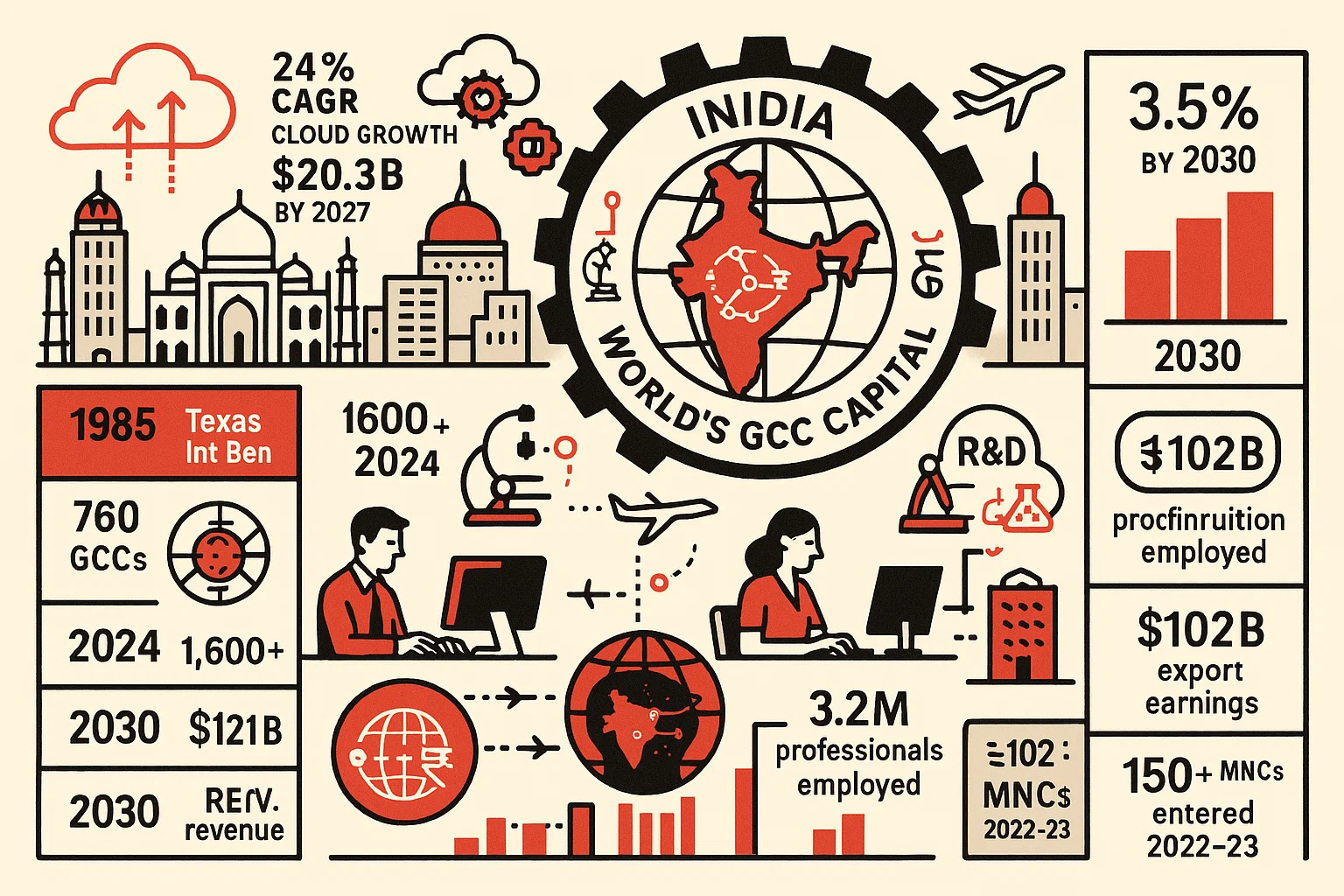
    However, digital platforms and the digitalization of brick-and-mortar sectors are growing rapidly, with the cloud market projected to expand at a compound annual growth rate (CAGR) of 24% from 2024 to 2027, reaching $20.3 billion by the end of 2027.

    But it’s the GCC sector that’s truly booming, with India emerging as the world’s GCC capital. GCCs are offshore centres established by multinational corporations to provide a variety of services to their parent organisations, including R&D, IT support, and business process management.

    GCCs, also known as global in-house centers (GICs), are offshore centers established by multinational corporations to provide a variety of services to their parent organizations, including research and development (R&D), IT support, and business process management.

    The report noted that nine of the top 22 GCCs in India are classified within the ICT sector, specifically computer-related services. These GCCs are driving innovation and growth in areas such as artificial intelligence, data analytics, and cybersecurity.

    India has solidified its position as a premier destination for Global Capability Centers(GCCs), with over 1,600 centers currently operating in the country, up from 760 in 2012.

    According to the finance ministry’s Economic Survey 2023-24, in 2022 and 2023 alone, more than 150 multinationals have set up their GCCs in India, drawn by the country’s vast talent pool, favorable business environment, and government support.

    The growth of GCCs in India dates back to 1985, when Texas Instruments established its office in Bengaluru, marking the beginning of the offshoring era. Since then, numerous airlines, technology companies, and other multinationals have followed suit, establishing their captive centers, now known as GCCs or GICs.

    According to a PwC report, the number of GCCs in India is projected to reach 2,100 by 2028, with the market size expected to touch $90 billion. A separate study by Wizmatic estimates that GCCs currently employ 3.2 million people, primarily engineers and scientists, and generated a combined revenue of $46 billion in 2023.

    By 2030, GCCs in India are expected to generate a total revenue of $121 billion, representing roughly 3.5% of the country’s GDP, with $102 billion coming from export earnings.

    The MEITY-ICRIER report also highlighted the growing importance of GCCs in driving economic growth and job creation in India. GCCs are estimated to have generated over $20 billion in revenue in 2022, and employ over 500,000 people directly and indirectly.

  • Naidu’s at it again! Andhra Pradesh CM lays out red carpet for GCCs

    Naidu’s at it again! Andhra Pradesh CM lays out red carpet for GCCs

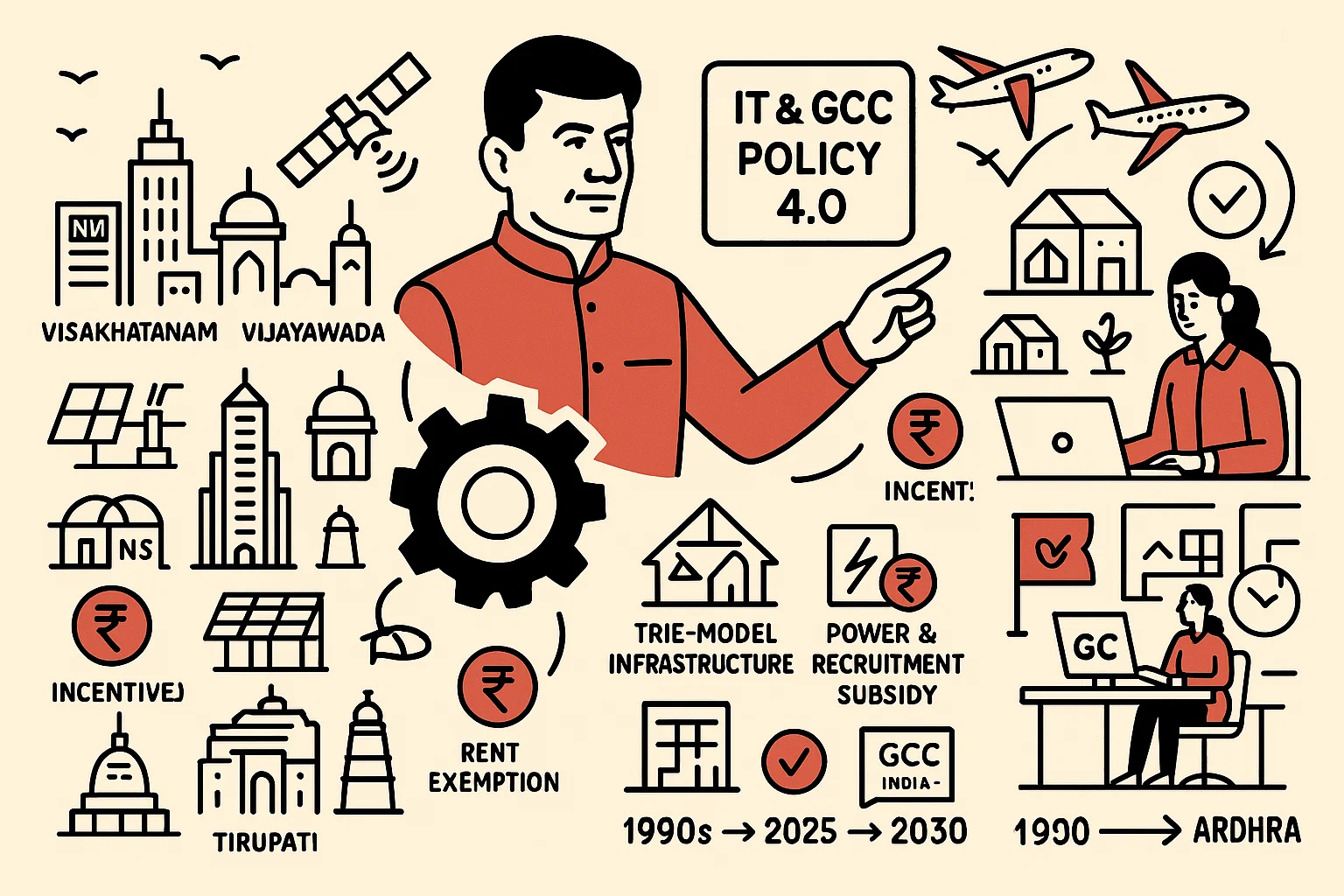
    Andhra Pradesh’s IT & GCC Policy 4.0 aims to attract MNCs with subsidies, infrastructure support, and incentives, strengthening India’s position as a global GCC hub.

    With the announcement of the Andhra Pradesh IT & GCC Policy 4.0 (2024-2029), chief minister N Chandrababu Naidu, true to his position as a one of India’s tallest pro-business and pro-investor leader, gave a significant boost to India’s broader ambition of becoming a global hub for GCCs (Global Capability Centres), a sector that is expanding exponentially due to the digital transformation of businesses worldwide.

    By offering them a clear infrastructure roadmap, substantial subsidies, and customized incentives, the policy seeks to attract multinational corporations (MNCs) and establish the state as a top destination for GCCs. It aims to create neighbourhood workspaces, co-working spaces, and IT campuses in major cities like Visakhapatnam, Vijayawada, and Tirupati.

    Naidu quickly took to Twitter where, in a long post, he wrote, “As we know, the work landscape underwent a shift during the COVID-19 pandemic. With technology readily available to scale… Concepts such as remote work, coworking spaces (CWS), and Neighbourhood Workspaces (NWS) can empower businesses and employees alike to create flexible, productive work environments. Such initiatives can help us strike a better work-life balance as well. We plan to harness these trends to drive meaningful change in AP. The Andhra Pradesh IT & GCC Policy 4.0 is a game-changing step in that direction. One of the key features of the policy is its three-model approach for infrastructure developers, which provides rental and financial subsidies according to the size and scope of the project. Businesses investing in GCCs and IT clusters will also profit from power incentives, recruiting subsidies, and early-bird incentives like rent exemptions in government buildings.”

    Long recognised as one of India’s most dependable chief ministers and a key proponent of attracting global investments to Andhra Pradesh, Naidu is in many respects a pioneer in his own right. He was instrumental in turning Hyderabad into a major global centre for information technology during his time as chief minister in the late 1990s and early 2000s, setting the stage for the city to draw in multinational behemoths like Google, Microsoft, and Oracle.

    Andhra Pradesh became an early pioneer in India’s IT revolution because of his pro-business stance, which has always placed a strong focus on infrastructure-first thinking and ease of doing business.

    In October last year, Naidu laid out the red carpet to investors unveiling six policies to foster economic growth, increase exports and create job opportunities. Formulated for the period 2024-2029, the new policies were aimed at mobilising ₹30 lakh crore investments and creating five lakh new jobs over the next five years in manufacturing sector alone.

    As MNCs increasingly turn to India for affordable, highly skilled labor, the state’s most recent GCC push is in line with India’s larger goal of becoming a global hub for GCCs. Naidu is once again using his vision to establish Andhra Pradesh as a top investment destination with the new IT & GCC Policy 4.0. His administration’s emphasis on improving digital infrastructure, offering investor-friendly policies, and simplifying administrative procedures guarantees that GCCs can successfully launch and grow their businesses.

    The state government has traditionally recognized the strong correlation between the IT and GCC sectors and has been committed to fostering growth in both sectors to develop a knowledge-based economy in the state and his policy in many ways mirrors this approach. Indeed, Andhra Pradesh’s strong push is expected to increase India’s global competitiveness in the GCC sector, as multinational corporations look for alternative centers outside the conventional IT locations.

    India will house over 620 new Global Capability Centres (GCCs) by 2030, which is over 32 percent of the Forbes 2000 enterprises, according to the ANSR Q3 GCC report, which also added India has over 450 Forbes Global 2000, with around 825 centers, and employs close to 13 lakh professionals. The report highlights that not only large corporations but also mid-market players and smaller enterprises are setting up bases in India.

  • GCCs Boost India’s Commercial Real Estate Sector

    GCCs Boost India’s Commercial Real Estate Sector

    India’s national GCC framework will boost commercial real estate, driving office space demand, investment, and job creation in metros and Tier-II/III cities, strengthening India’s global business position.


    India’s commercial realty space is poised to receive a significant boost from the growing presence of Global Capability Centres (GCCs), with the government’s proposed national framework expected to fuel office space demand in major metros and Tier-II and Tier-III cities.

    Finance Minister Nirmala Sitharaman announced in the Union Budget on February 1 that the government will introduce a national guidance framework to help states attract and promote GCCs, strengthening India’s position as a global business hub.

    GCCs, which account for over 30% of total absorption in Tier 1 cities, are growth catalysers of India’s office leasing market, according to ratings and research firm CareEdge Ratings. The firm noted that the government’s plan to introduce a national framework for GCCs will drive the creation of new leasing hubs, along with the development of commercial parks.

    Real estate experts were of the view that the proposed national framework for GCCs is a significant development for India’s commercial realty space. It will not only fuel office space demand but also create new opportunities for developers and investors.

    The growth of GCCs in India has been driven by the country’s large talent pool, cost competitiveness, and favourable business environment. Major metros like Bengaluru, Mumbai, Hyderabad, Pune, and Chennai have emerged as hubs for GCCs, with many global companies setting up their innovation and technology centres in these cities.

    The proposed national framework is expected to further accelerate the growth of GCCs in India, with Tier-II and Tier-III cities emerging as new destinations for these centres. 

    This, in turn, will drive demand for office space, create new job opportunities, and contribute to the growth of India’s economy.

    As India’s commercial realty space continues to evolve, the growth of GCCs is expected to play a significant role in shaping the sector’s future. With the government’s proposed national framework, India is poised to strengthen its position as a global business hub, attracting more foreign investment and driving economic growth.