
Tag: GCC India

  • India’s Office Market Booms as Global Capability Centres Drive Demand

    India’s Office Market Booms as Global Capability Centres Drive Demand

    GCC Hub Team

    India’s commercial real estate sector is experiencing a significant shift, driven by a surge in demand from Global Capability Centres (GCCs), according to a report by Realty+. The rapid growth of GCCs is reshaping office leasing patterns, with significant implications for the short-term and long-term future of India’s office space market.

    Between 2022 and the first half of 2024, GCCs leased an impressive 53 million square feet of office space in India, accounting for 36% of the country’s rental workspace, a report by ANSR said. This has taken the total occupied office space by GCCs to around 160.8 million square feet, or 32% of India’s total office stock.

    The trend is expected to continue, with GCCs projected to occupy 42% of India’s rental workspace by 2026. This growth is driven by India’s strong talent pool, favorable business environment, and the country’s ability to adapt to changing global business needs.

    Bengaluru, Hyderabad, and Chennai are the top three cities driving this demand, accounting for 75% of GCC leasing activity. Bengaluru leads with a dominant 40% share, followed by Hyderabad at 21% and Chennai at 14%. These cities offer a combination of infrastructure, talent, and connectivity that makes them attractive to GCCs.

    Technology companies are the biggest drivers of demand, accounting for 47% of GCC leasing activity. Flexible space providers follow closely at 19%, and the BFSI (banking, financial services, and insurance) sector makes up 16% of the demand. The manufacturing sector also contributes 9% to the overall demand.

    While traditional office hubs like Bengaluru’s Outer Ring Road and Hyderabad’s Gachibowli area remain popular, newer micro-markets are gaining traction. In Bengaluru, areas like Hebbal and Whitefield are emerging as hotspots, while in Pune, areas like Kharadi, Hinjewadi, and Baner are seeing increased demand. Other major markets, such as Delhi/NCR, Mumbai, and Pune, are also seeing increasing demand from GCCs.

    Sustainability is also becoming a key priority, with over 75% of leasing in 2022 concentrated in pre-certified green buildings. This trend is expected to accelerate as corporate occupiers and developers prioritize sustainability in their decision-making processes.

    The growth of GCCs in India is a testament to the country’s growing importance as a global business hub. As the demand for office space from GCCs continues to grow, it is likely to have a significant impact on the Indian economy, driving growth, creating jobs, and increasing India’s competitiveness in the global market.

    The demand for office space from GCCs is expected to continue to drive growth in India’s commercial real estate sector, with significant implications for the country’s economy and business landscape. As the trend continues, it will be interesting to see how the market adapts to meet the changing needs of GCCs and other occupiers.


  • Flutter’s Hyderabad Global Capability Centre surpasses 1,000 employees

    Flutter’s Hyderabad Global Capability Centre surpasses 1,000 employees

    GCC Hub Team

    Flutter Entertainment has reached a major milestone in the growth of its business in India. The company’s Global Capability Centre (GCC)-Flutter Entertainment India LLP (FEI) delivers a broad spectrum of capabilities and is based in RMZ Spire, Knowledge City, Hyderabad, has now surpassed the 1,000-employee mark, highlighting its rapid growth and strategic importance within the Flutter ecosystem, the company said in a statement.

    Local hiring grew by 60% in the past year, positioning Flutter Entertainment India as a critical enabler of Flutter’s global operations and strengthening its capabilities in Data & Technology, HR Tech and Analytics, Finance, Customer Support Operations, and Shared Services.

    As part of Flutter’s global sustainability strategy, the Positive Impact Plan, Flutter allocated GBP 30,000 to local initiatives in Hyderabad in 2024 to support cancer screening for 550 women and education in Data Science and Machine Learning for 76 students. In recognition of the initiative’s impact and Flutter’s commitment to ‘Do More,’ Flutter has doubled its investment in local initiatives for 2025.

    Peter Jackson, Chief Executive Officer of Flutter, recently visited the Hyderabad GCC (FEI) and offices of Junglee Games (Gurgaon), Flutter’s leading Indian rummy brand.

    During this visit, he spent time with local leadership, engaged with employees across teams, and participated in a fireside chat that highlighted Flutter’s innovation journey, organizational culture, and vision for continued growth in the region.

    Speaking on the sidelines during his visit to India, Peter Jackson, CEO Flutter, said, “India is a key growth market for Flutter, and the Hyderabad GCC is integral to our continued expansion in the region. It’s been great to see the teams at the GCC grow over the past year and I’ve been hugely impressed by their role in providing our world-class brands with technology capabilities, another great example of the Flutter Edge in action.”

    Ashish Sinha, Managing Director of Flutter Entertainment Indiasaid, “The past year has been a transformative journey for Flutter in India. Since launching our state-of-the-art GCC in Hyderabad, we’ve tapped into the city’s exceptional talent and embraced India’s rising prominence as a GCC. Our vision goes beyond operational scale—we’re building a centre of tech excellence and innovation that supports Flutter’s growth globally. Additionally, through Flutter’s ‘Do More’ strategy, we’re committed to giving back to the communities where we live, work and play. Our next phase of growth will focus on our deepening expertise and further reconciling with Flutter’s global strategies.”

  • Ferguson Launches Global Capability Centre Powered by ANSR in Bengaluru

    Ferguson Launches Global Capability Centre Powered by ANSR in Bengaluru

    Ferguson, the largest value-added distributor of plumbing and heating products—particularly in the North American construction market—has announced the launch of its Global Capability Centre (GCC) in Bengaluru, established in partnership with ANSR.

    This new centre marks a significant milestone in Ferguson’s digital transformation journey and its commitment to delivering world-class customer experiences through innovation and technology.

    Teaming up with ANSR, a global leader in setting up and operating GCCs, the Ferguson GCC will serve as a strategic extension of its operations, playing a significant role in driving technology innovation and operational efficiencies. Ferguson’s investment in India is aimed at meeting evolving customer needs.

    “This is not just about scaling technology, it’s about building a future-ready organization,” said Arvind Rathore, Acting Managing Director for the Ferguson GCC powered by ANSR. “Our Bengaluru GCC is a strategic investment to ensure constant innovation and development capabilities. We’re excited to be in a city known for its technology leadership, and we’re building a team that will help drive digital solutions for the specialized trade professional.”

    The GCC will play a critical role in enabling Ferguson’s technology roadmap, particularly in areas such as software engineering, AI, Enterprise Resource Planning, Customer Relationship Management, data science, analytics and network operations.

    Lalit Ahuja, Founder & CEO of ANSR said, “The Ferguson GCC powered by ANSR reflects the company’s long-term commitment to technology-led growth, and ANSR is proud to partner in creating a high-performing innovation engine in India that complements Ferguson’s growth strategy.”

    Rather than relocating existing roles, the Ferguson GCC will serve as a complementary hub, driving scalability, speed, and agility across global development initiatives. The center presents exciting career opportunities for India’s top tech talent and is expected to scale significantly over the next five years, with more than 50 associates already on board. In the near future, it will also be home to several key leadership positions.

    The Ferguson GCC is focused on creating an environment where engineers and innovators can work with the latest technologies. Professionals in India will have the opportunity to build next-generation solutions for one of the world’s largest and most critical industries.

  • India’s GCCs Face Significant Gender Pay Gap, Study Finds

    India’s GCCs Face Significant Gender Pay Gap, Study Finds

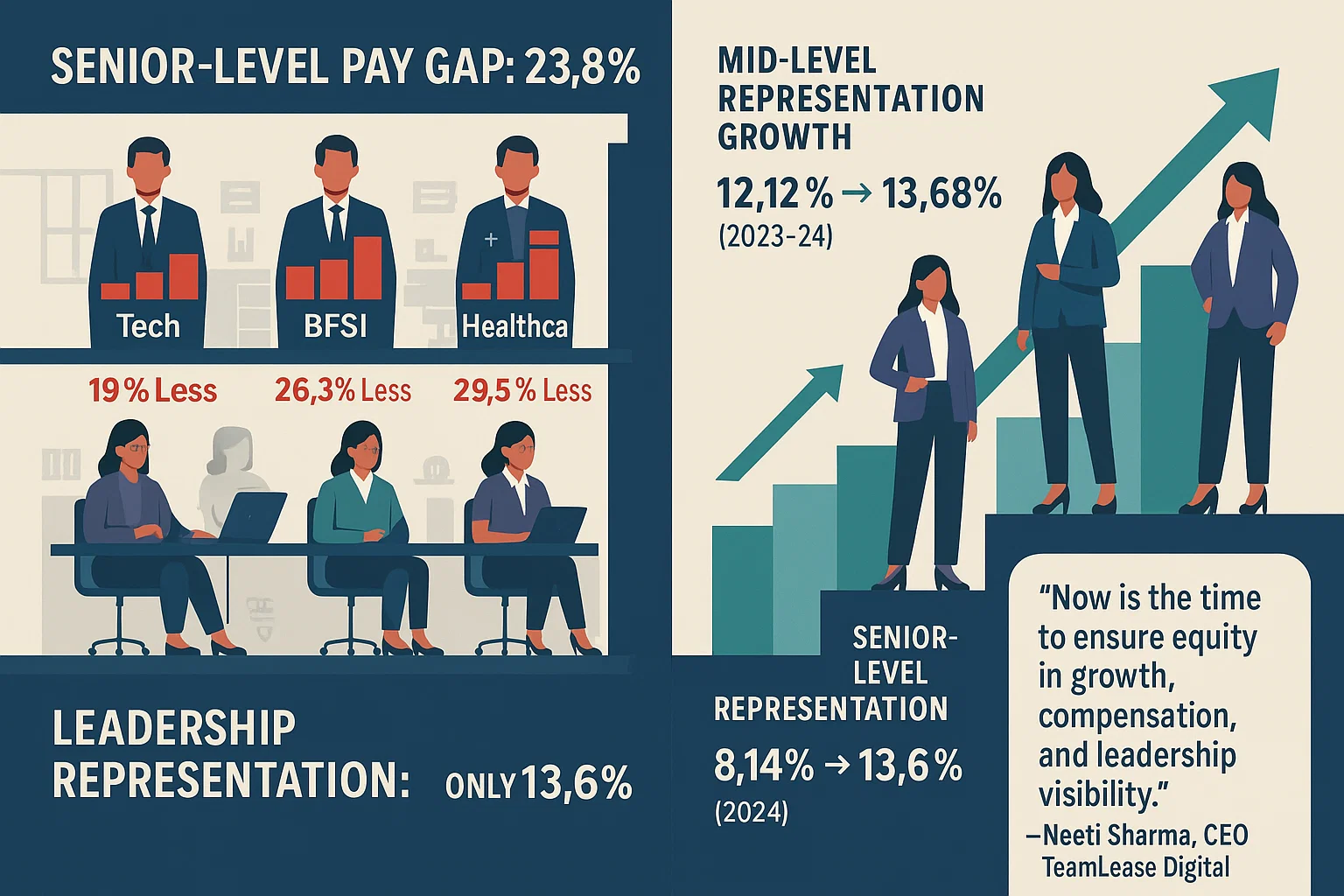
    India’s rapidly growing Global Capability Centres (GCCs) sector is grappling with a substantial gender pay gap, with women earning up to 16.4% less than their male counterparts, according to a recent study by TeamLease.

    The pay disparity is particularly pronounced in senior and technical roles, where women face significant obstacles to career advancement. In the BFSI (Banking, Financial Services, and Insurance) segment, women earn an average of 26.3% less than men, with the gap widening to 23.8% at senior levels, the New Indian Express reported citing the study.

    The study highlights the challenges faced by women in GCCs, despite the sector’s growth and increasing demand for talent. While GCCs have made progress in promoting women to mid and senior-level roles, with the percentage of women in mid-levels growing from 12.12% in 2023 to 13.68% in 2024, and senior levels witnessing a growth from 8.14% in 2023 to 13.60% in 2024, the pay gap remains a significant issue.

    The pay gap varies across sectors, with Lifesciences and Healthcare GCCs showing a staggering 29.5% pay gap, and a 23.5% disparity at senior levels. In contrast, tech GCCs fare slightly better, with an overall pay gap of 19%.

    Neeti Sharma, CEO of TeamLease Digital, emphasized the need for organizations to address the systemic challenge of gender pay equity. “The GCC ecosystem in India presents a powerful opportunity to drive change and inclusivity,” she said. “While the sector has made considerable progress in elevating women into meaningful roles, the gender pay gap reveals a deeper systemic challenge. Now, it is time for organizations to ensure equity in growth, compensation, and leadership visibility.”

    The study’s findings highlight the need for GCCs to prioritize diversity, equity, and inclusion initiatives to address the pay gap and promote women’s career advancement. As the GCC sector continues to grow and play a critical role in India’s economy, addressing these challenges will be crucial to ensuring equal opportunities for all employees.

  • Workday Establishes Global Capability Centre in Chennai with Rs 220 Crore Investment

    Workday Establishes Global Capability Centre in Chennai with Rs 220 Crore Investment

    GCC Hub Team

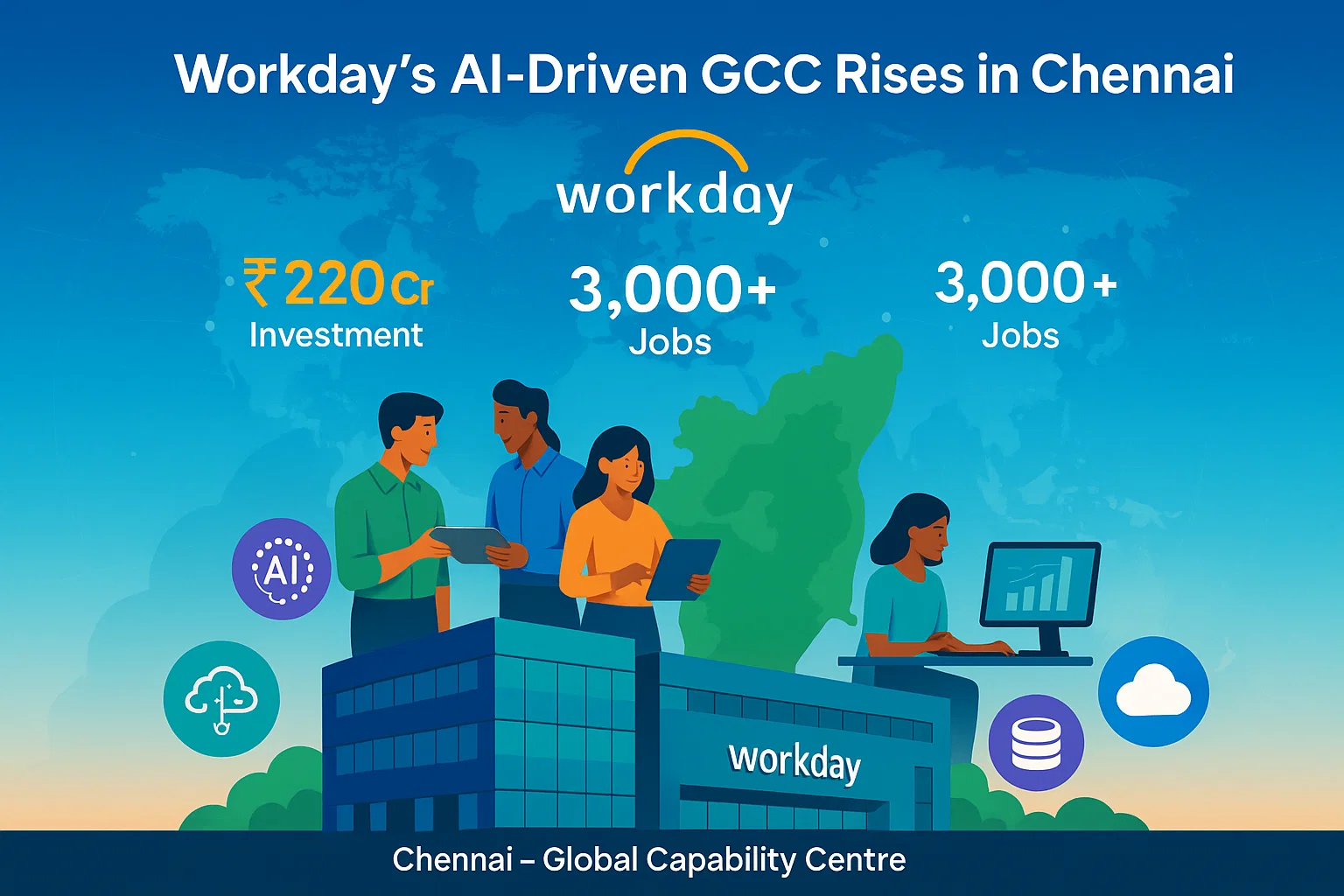
    US-based cloud-based software provider Workday is setting up a Global Capability Center (GCC) in Chennai, Tamil Nadu, with a significant investment of around Rs 220 crores. 

    This strategic hub for product and technology development will support Workday’s global operations, focusing on next-generation Artificial Intelligence technologies, and create up to 3,000 jobs, said a social media post put out by Tamil Nadu’s Industries Minister TRB Rajaa on April 28.

    The company signed a Memorandum of Understanding (MoU) with Guidance TN, the state’s investment promotion agency, marking a significant step in establishing its presence in the region. This move underscores the growing appeal of Tamil Nadu as a hub for GCCs, with over 250 centres already operational in the state.

    Workday’s GCC in Chennai will leverage India’s vast talent pool and cost-effective business environment, allowing the company to drive innovation and operational efficiency. The centre will focus on developing cutting-edge AI technologies, further solidifying India’s position as a leader in the global GCC landscape.

    Workday’s decision to establish a GCC in Chennai is a testament to the state’s attractive business environment and talent pool. With over 1,700 GCCs already operational in India, the country is poised to become an even more prominent hub for global companies. Workday’s recent financial performance, with revenues of $8.44 billion for the fiscal 2025 fourth quarter and full year, also highlights the company’s growth trajectory

  • India Emerges as Prime Location for Aviation Global Capability Centres

    India Emerges as Prime Location for Aviation Global Capability Centres

    GCC Hub Team

    A new whitepaper by Nasscom has highlighted India’s potential as a strategic location for Global Capability Centres (GCCs) in the aviation industry, driven by its skilled talent pool, cost advantages, advanced digital infrastructure, and progressive government policies. 

    The whitepaper has presented a comprehensive roadmap for establishing GCCs in India, tailored to the aviation sector, and outlines the benefits of leveraging India’s rapidly maturing aerospace ecosystem.

    The aviation industry is on the cusp of substantial expansion, with the global market expected to reach $771.26 billion by 2029, growing at a compound annual growth rate (CAGR) of 4.36% from 2025 to 2029. However, the industry faces numerous operational challenges, including rising fuel prices, complex maintenance regimens, stringent regulatory compliance, and supply chain vulnerabilities.

    Establishing GCCs in India can help aviation companies address these challenges by streamlining operations, reducing overhead costs, and accessing specialized talent and advanced technologies. The GCC model centralizes critical functions such as IT, engineering, R&D, and customer support in cost-efficient offshore locations, benefiting both mid-size and large aviation companies.

    The Indian government has taken initiatives to promote the aviation sector, including improving policies to increase connectivity and tourism, rationalizing ATF taxes, and developing infrastructure. 

    The Ministry of Civil Aviation’s total budget for 2025-26 is Rs 2,400.31 crore, including Rs 70.00 crore for capital expenditure on development. Schemes like UDAN aim to create opportunities for aviation companies to tap into new markets, particularly in Tier-II and Tier-III cities.

    India’s labour cost differential, significantly lower than Western counterparts, can facilitate potential operational savings of up to 30-40%. Additionally, India’s logistical scalability, coupled with strong governmental support, positions it as an optimal nexus for technological innovation and operational augmentation within the aviation sector.

    The whitepaper has suggested that key strategies for sustainable growth in the aviation industry include enhancing MRO (Maintenance, Repair, and Overhaul) capabilities, forming public-private collaborations, and prioritizing talent development. The establishment of GCCs in India can help aviation companies capitalize on these opportunities and drive sustainable innovation, operational resilience, and competitive advantage.

    By leveraging India’s advanced digital infrastructure, progressive government policies, and abundant reservoir of skilled labour, aviation companies can optimize operational performance and achieve long-term profitability. The confluence of technological evolution, strategic alliances, and judicious investment in talent development will underpin the industry’s trajectory, engendering a paradigm shift towards heightened efficiency, sustainability, and global competitiveness.

  • Episode 5: India’s GCCs: Powering AI & Progress

    India’s 1,700+ Global Capability Centres are driving a quiet revolution in AI—transforming healthcare, finance, and aviation at lightning speed. As global giants pour billions into innovation hubs, office skylines rise and tech talent booms. But beneath the success lies a reckoning: stark gender pay gaps, data privacy dilemmas, and the race to build ethical, inclusive AI at scale.

  • India’s GCCs poised for strategic realignments

    India’s GCCs poised for strategic realignments

    GCC Hub Team

    India’s Global Capability Center (GCC) hiring landscape is undergoing a significant transformation, driven by seasonal patterns, sector-specific dynamics, evolving attrition rates, and macroeconomic factors. 

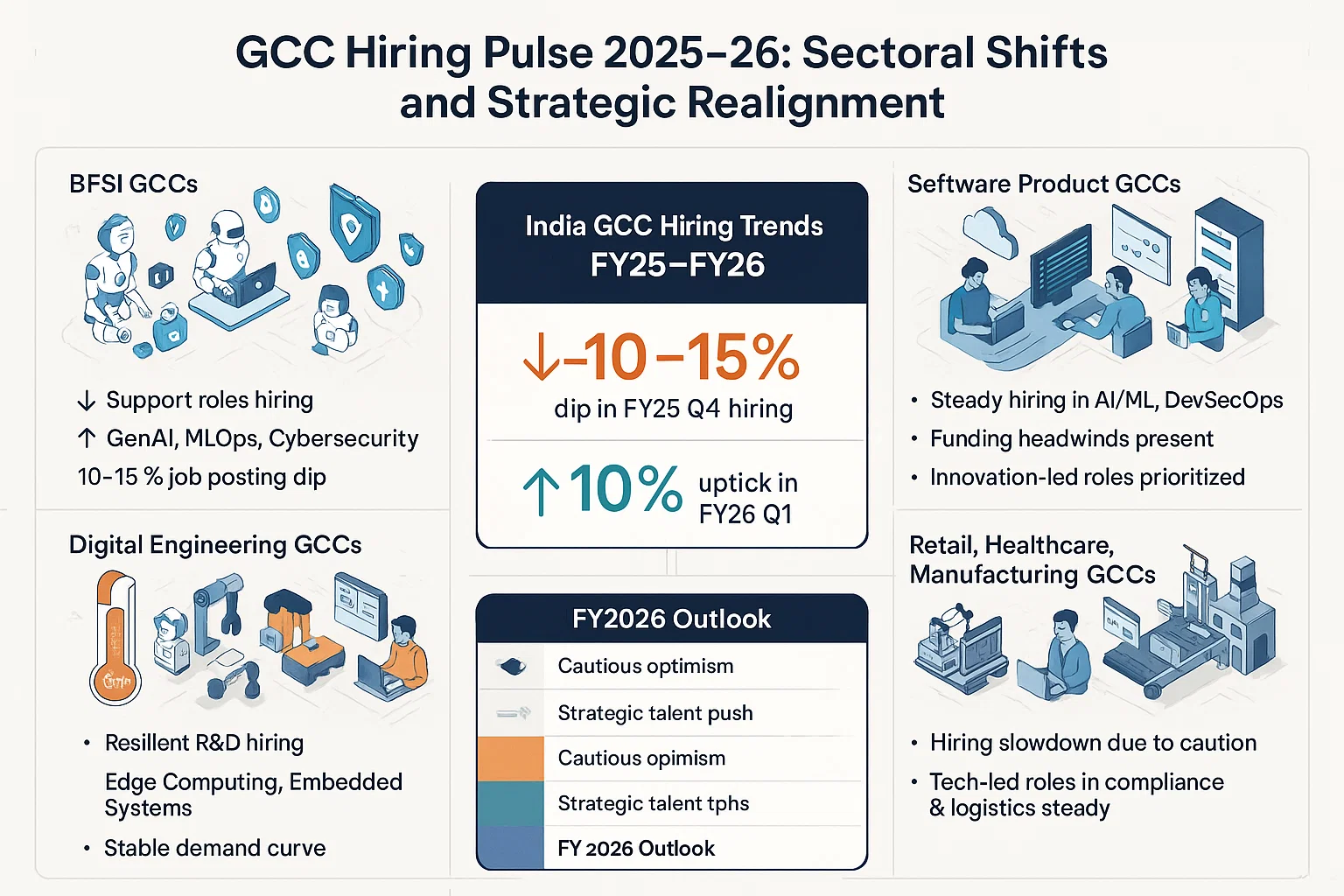
    According to a post by industry body Nasscom, sourcing data from talent solutions company Han Digital, GCC hiring in India is slowing down in FY25, with a noticeable dip of 10-15% in hiring demand in the final quarter of the fiscal year.

    Sectoral Trends:

    BFSI GCCs: Deceleration in hiring, particularly for support and operational roles, with a strategic focus on automation and AI-driven tasks. Demand for niche skillsets in areas like Generative AI, MLOps, cybersecurity, and financial modeling is on the rise, while job postings declined 10-15% in Q1 2025.

    Software Product GCCs: Stabilized hiring with emphasis on roles within AI/ML, cloud engineering, DevSecOps, and product-led growth, despite funding challenges for startups.

    Digital Engineering GCCs: Remarkable resilience, driven by high-end R&D in domains like embedded software, edge computing, IoT, and digital twin technologies, with robust demand for high-value roles.

    Retail, Healthcare, and Manufacturing GCCs: General slowdown in hiring due to macroeconomic caution, but stable hiring persists in specialized areas like health tech compliance and supply chain automation.

    Attrition and Hiring:

    Attrition rates hover between 12-15% annually, necessitating consistent backfilling efforts. Larger GCCs exhibit higher monthly job postings during the first three quarters, followed by a reduction in hiring activity in the final quarter.

    Outlook for FY2026:

    As per Nasscom, citing Han Digital, “The GCC hiring landscape is poised for strategic realignments, with a cautious hiring sentiment expected for support and operations roles.” However, GCCs will likely resume targeted hiring in critical areas like Generative AI, platform engineering, and data security. A modest uptick of up to 10% in job postings is expected compared to the final quarter of FY2025.

    Key Predictions:

    BFSI GCCs: Focus on specialized roles over volume hiring.

    Software Product GCCs: Cautious yet strategic approach to investments in innovation-driven talent.

    Digital Engineering GCCs: Resilience with hiring aligned to next-generation engineering priorities.

    Retail and Healthcare GCCs: Proceeding with caution while integrating technology strategically.

  • India’s GCC Sector to Create 400,000 Fresher Jobs by 2030: Report

    India’s GCC Sector to Create 400,000 Fresher Jobs by 2030: Report

    GCC Hub Team

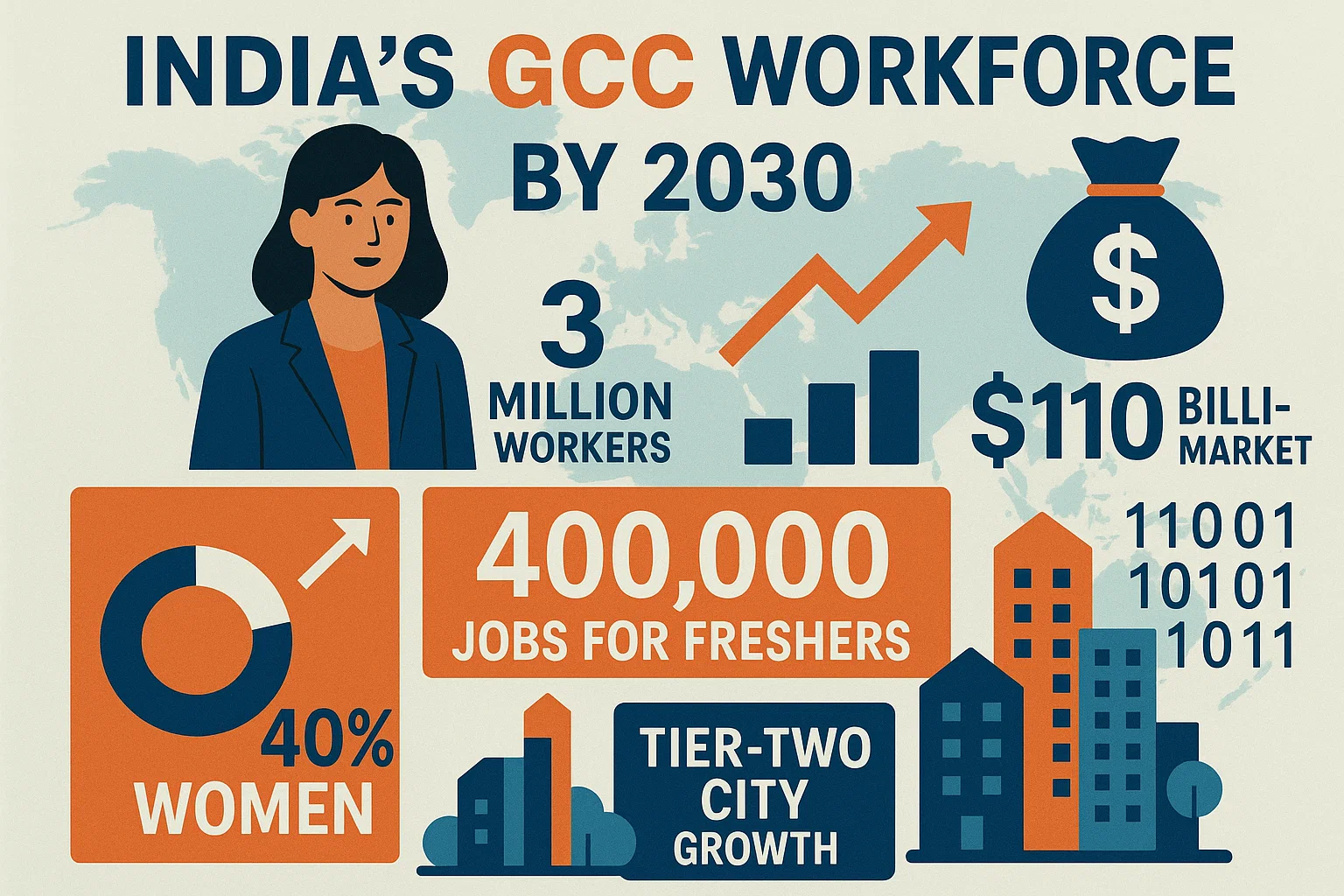
    India’s Global Capability Centre (GCC) workforce is projected to reach 3 million by 2030, creating approximately 400,000 jobs for freshers, according to a report by HR investment platform FirstMeridian.

    The GCC ecosystem in India is growing rapidly, driven by a diverse talent pool, high digital literacy, cost advantages, and the involvement of various industries, including IT, AI/ML, and data engineering.

    The report estimates that the GCC market in India will be worth $110 billion by 2030, leading to the creation of around 150,000 jobs by 2026. A significant portion of these jobs, around 100,000, will be entry-level positions for freshers, contributing to economic growth. Tier-two cities are playing a crucial role in expanding the Indian GCC sector, offering a growing talent pool, affordable infrastructure, lower attrition rates, and cost savings.

    Women currently make up 40% of the GCC workforce in India, and this figure is expected to rise as inclusion efforts continue. The report predicts a 3-5% improvement in gender diversity in the GCC workforce, as companies prioritize diversity, equity, and inclusion (DEI).

    While the GCC sector presents numerous opportunities, it also faces challenges such as salary expectations, digital skill gaps, cybersecurity risks, talent retention, and regulatory complexities. To address these issues, proactive measures such as simplified SEZ policies, improved digital infrastructure, strong data protection laws, and streamlined tax frameworks are necessary.

    With its strong talent pool, favorable business environment, and government support, India has established itself as a GCC powerhouse. The country’s GCC sector is aligned with its self-reliance goals, and significant investments are being made in upskilling programs to prepare the workforce for global markets. With continued focus on skill development and supportive policies, India holds great promise for its workforce and businesses.

  • Episode 4: GCC Momentum Accelerates Amid Emerging Challenges

    India’s Global Capability Centers (GCCs) are reshaping industries–from gaming to banking–gaining momentum across sectors, driving innovation and efficiency for multinational and Indian corporations alike. While companies like Infosys and HCLTech double down on GCC opportunities, Cognizant flags rising competition. Hiring is undergoing strategic realignments, even as demand for specialized talent grows. India’s cost advantage and innovation push position it as the world’s leading GCC hub.