Tag: GCC India

  • GCCs Struggle with Talent Retention as Workforce Demands Evolve

    GCCs Struggle with Talent Retention as Workforce Demands Evolve

    Global capability centres (GCCs) are grappling with a significant talent retention challenge, as employee expectations and hiring trends undergo a seismic shift, a recent study by CIEL HR reveals. About 52% of the GCC workforce is actively considering new job opportunities, driven by a desire for career progression, flexibility, inclusivity, and purpose. This trend is forcing GCCs to rethink their strategies for attracting and retaining top talent in a highly competitive market.

    The study highlights that 51% of GCCs in India cite talent retention as their top challenge, amid rising attrition and job-switching intent. Despite the challenges, GCCs are offering significantly higher compensation, ranging from 12% to 20% above traditional IT services, to attract and retain top professionals in high-demand domains such as AI, machine learning, and cloud computing. The talent war is particularly intense among tech-forward enterprises, where deep digital expertise is non-negotiable.

    According to the study, 55% of product development professionals and 45% of IT employees are currently exploring new job opportunities, while 28% of executives across IT, financial services, and manufacturing have already changed jobs in the past year. This trend underscores the need for GCCs to adopt a more nuanced approach to talent management, one that goes beyond mere compensation and benefits.

    Aditya Narayan Mishra, Managing Director & CEO of CIEL HR, notes that India’s pivotal role in global innovation and high-value delivery is underscored by the presence of over 1,700 GCCs in the country. However, he emphasises the need for a decisive shift from transactional approaches to holistic employee engagement. 

  • Episode 9: Trends, Talent, and Tech

    In this episode of The GCC Hub Podcast, we dive into the latest trends and insights shaping the future of Global Capability Centres in India. From the semiconductor design sector’s 15% decline in job openings to Bengaluru’s rise as a global tech powerhouse, we cover it all. Tune in for expert analysis and key takeaways on:

    • India’s semiconductor design sector sees a 15% decline in job openings amid global uncertainty
    • Bengaluru tops fresher hiring in the GCC sector
    • GCCs propel Bengaluru as a global tech powerhouse
    • The global BFSI market to expand significantly, with India GCCs leading growth
    • India’s GCCs face talent shortage, must adapt to stay competitive
    • Measuring GCCs’ performance in the age of AI

    Listen Now and Stay Ahead!

  • Episode 8: GCCs behind UP’s $1T Bet & National Boom

    Once quiet outposts of outsourced support, Global Capability Centres (GCCs) have become the braintrusts of global corporations—driving enterprise innovation, job creation, and high-value investments across sectors like BFSI, engineering, and healthcare. With enabling policies, deep talent pools, and cost-efficient scale, India is fast becoming the preferred destination for global firms to centralize operations. From payroll subsidies to AI-led innovation hubs, the GCC momentum is reshaping India’s economic future. In India, they are no longer confined to the traditional metropolitan hubs. From Uttar Pradesh’s $1 trillion GDP push to a nationwide surge in high-value employment and commercial real estate, GCCs are quietly redrawing the economic map. As boardrooms bet big on India’s talent, GCCs stand at the intersection of geopolitics, growth, and global rebalancing.

  • Episode 7: GCCs on Edge: Adapt or Become Obsolete

    As global volatility escalates, Global Capability Centres (GCCs) are becoming strategic nerve centers—not just delivery arms. In Episode 7, we explore how India’s booming GCC sector, backed by giants like JPMorgan Chase, Mercedes-Benz, SAP, and Walmart, is futureproofing itself against geopolitical risks, regulatory flux, and digital disruption. With Bengaluru emerging as the AI capital, and firms like TCS and Sabre expanding aggressively, the message is clear: resilience, reinvention, and relevance are the only paths forward.

  • India’s GCCs Drive Tech Hiring Amid Muted IT Sector Growth

    India’s GCCs Drive Tech Hiring Amid Muted IT Sector Growth

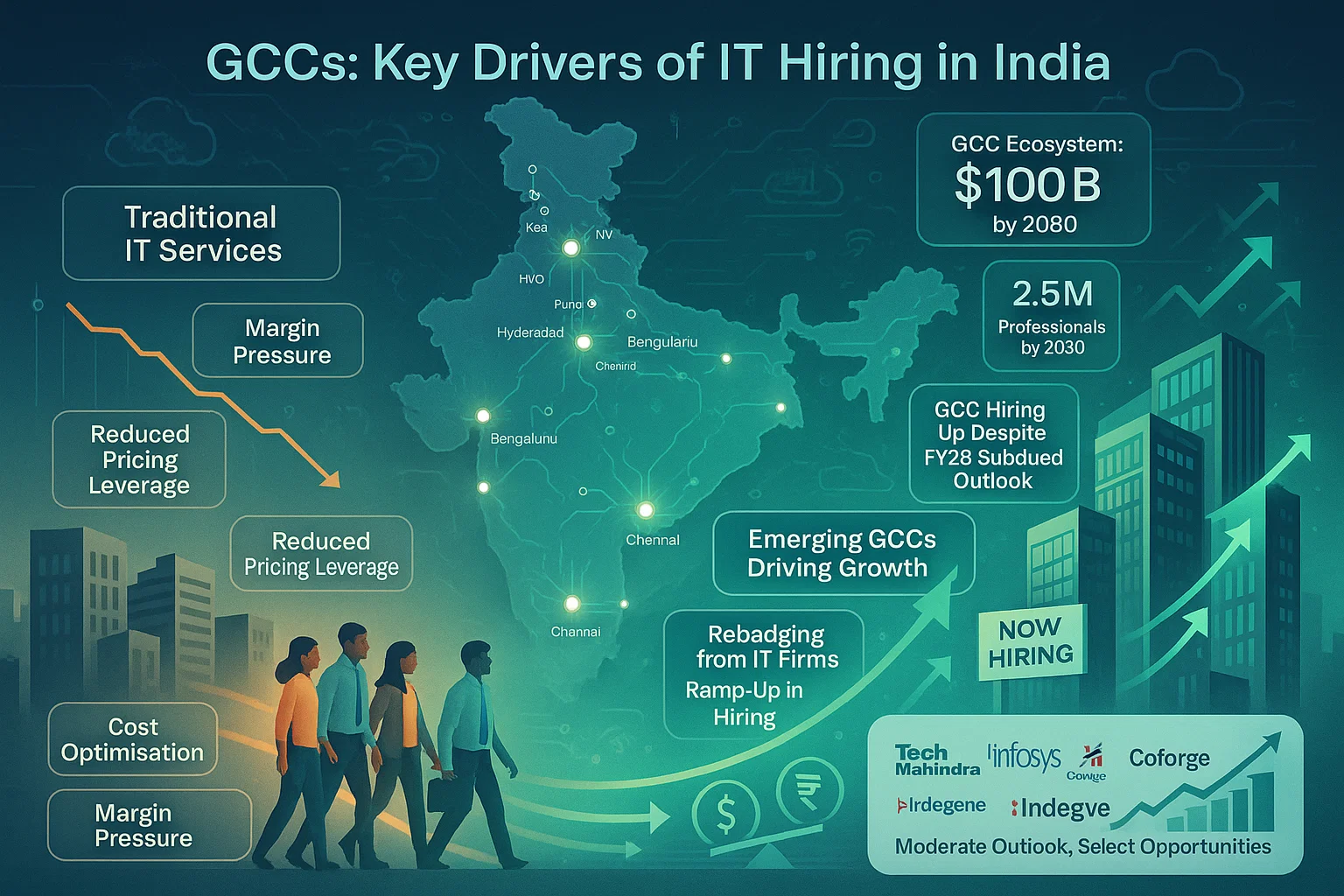
    Global Capability Centres (GCCs) in India are emerging as key drivers of IT hiring, according to a recent report by Kotak Institutional Equities. Despite a subdued outlook for the IT sector in FY26 due to US tariffs and ongoing cost optimisation, GCCs are expanding in India, fuelling headcount growth by hiring talent from traditional IT-service firms.

    The report highlights that GCC hiring continues to be on a growth trajectory, driven by the ramping up of Greenfield GCCs, which are becoming major growth drivers and taking the lead in overall hiring across the IT sector. Existing GCCs have seen some moderation, but the overall trend remains supportive.

    The expansion of GCCs is impacting traditional IT companies’ growth and margins, with deal activity driven by cost optimisation rather than expansion or innovation, affecting margins and reducing pricing leverage and profitability.

    India’s GCC ecosystem is projected to reach US$100 billion in value by 2030 and employ over 2.5 million professionals. Greenfield GCCs are driving growth with expansion led by the rebadging of employees from IT-services companies. However, the cost of operating GCCs remains high, with divided opinions on whether it is higher than that of traditional-IT services.

    Kotak Institutional Equities forecasts a moderate outlook for the IT sector in FY26, with a balanced view on IT sector stocks, and companies such as Tech Mahindra, Infosys, Hexaware, Coforge, and Indegene are top picks for the firm, expecting moderation in fresh investment in engineering, research and development sectors assuming slow US economic growth.

  • Women in Leadership: The Not-So-Quiet Revolution Inside India’s GCCs

    Women in Leadership: The Not-So-Quiet Revolution Inside India’s GCCs

    The corridors of India’s Global Capability Centres (GCCs) are humming with change. Once dominated by monochromatic (read: masculine) visions of leadership, these spaces are now reflecting a new spectrum—one painted with ambition, resilience, and the unmistakable force of women in power. This is not a slow creep toward equality; it’s a quiet revolution, reshaping the very fabric of corporate governance in India’s most cutting-edge sectors.

    Between 2020 and 2024, the number of women in India’s GCC workforce surged from 31.4% to 38.3% (Source). This is evidently a deliberate, data-backed shift. Even more striking is the rise of women in senior leadership roles—from a modest 8.14% to a formidable 13.6% (Source). This isn’t a trend; it’s a trajectory.

    To put it plainly, women are no longer just entering the room; they are now sitting at the table and, increasingly, taking leadership positions at the head of it.

    Trailblazers and Change-Makers

    At the forefront of this movement are leaders like Sirisha Voruganti, CEO & MD of Lloyds Technology Centre India, who transitioned from a tech specialist to a C-suite executive in an industry where the glass ceiling was once almost unbreakable. Her journey is one of grit and vision, a testament to what happens when merit meets opportunity. Then there’s Sreema Nallasivam, CEO of Metro Business Solution Centre, who clawed her way through biases that once threatened to stifle her career. She didn’t just survive those battles—she thrived. 

    Or take Kalavathi GV, Executive Director at Siemens Healthineers Global Development Centre, whose leadership style is a masterclass in democratic decision-making. Her teams don’t just work; they innovate, collaborate, and flourish under her guidance.

    These aren’t mere outliers – they are harbingers of a new leadership ethos; one that values inclusivity, collective growth, and transformative impact.

    Cracks in the Glass Ceiling

    But while the headlines may trumpet these successes, the undercurrents of challenge are real. A yawning gender pay gap remains, with women in senior roles earning 16.4% less than their male counterparts (Source). The cracks of disparity are visible, even as the surface glistens with progress. Societal biases, the silent constraints of age, and the relentless tug-of-war between career and personal life still mark the paths of many aspiring women leaders. For too many, mid-career growth coincides with life transitions—motherhood, family obligations, health considerations—each one a reason for organizations to pause before promoting, to hesitate before investing.

    It’s a sobering reality: while the doors to leadership are more open than ever, the path remains steep for those who dare to climb.

    A Path Forward: Redefining the Table

    And yet, the momentum is undeniable. India’s GCCs are waking up to the economic logic of inclusion. Studies repeatedly show that gender-diverse leadership teams outperform their counterparts on metrics of profitability, innovation, and employee satisfaction. This isn’t altruism—it’s strategy. For every Sirisha or Sreema who ascends, the path widens a little more for those who follow. It’s a ripple effect that is impossible to contain.

    To truly capitalize on this momentum, GCCs must shatter the last of their glass ceilings, not just with symbolic appointments but with systemic change. The answer lies not just in policies but in culture: mentorship that transcends hierarchy, flexible work policies that acknowledge life beyond the office, bias training that dismantles unconscious prejudice, and pay structures transparent enough to reveal—and rectify—disparity.

    Because the rise of women in India’s GCCs is not just about adding more seats at the table. It’s about redefining the table itself. When the dust of tradition finally settles, it will reveal what it always should have — a room where leadership isn’t just male or female. It’s simply powerful.

    The revolution is here. And it’s only just begun.

  • India’s Global Capability Centres Poised for 9.9% Average Salary Hike in 2024

    India’s Global Capability Centres Poised for 9.9% Average Salary Hike in 2024

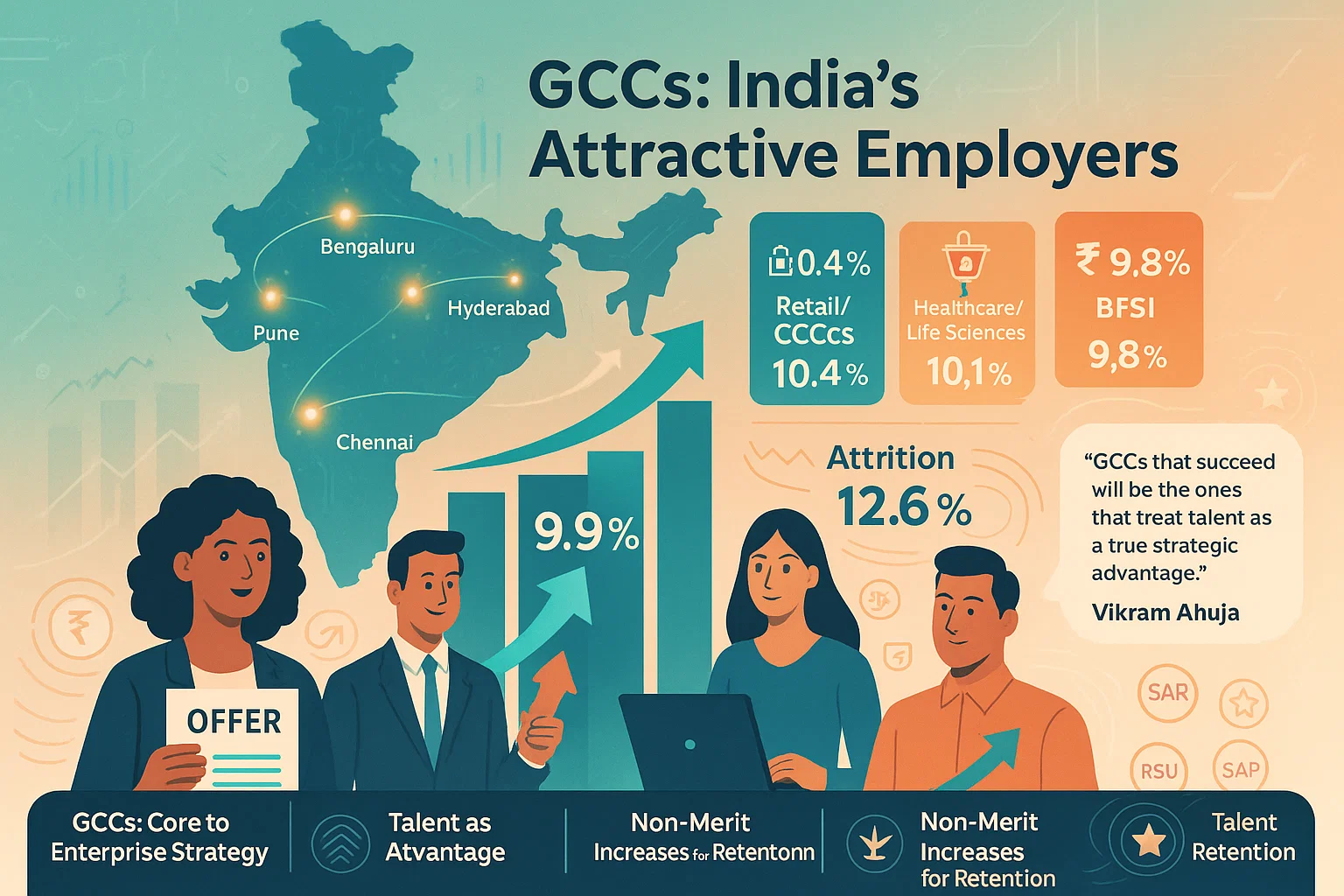
    Global Capability Centres (GCCs) in India are emerging as attractive employers, with a projected average salary hike of 9.9% this year, according to a report by Talent500 by ANSR. This growth rate outpaces services companies (8.1%) and is slightly below product companies (9.3%). 

    The high demand for skilled professionals within GCCs continues to drive salary increases.

    The report highlights that Retail/CPG GCCs will witness the highest salary increase at 10.40%, followed by healthcare/life sciences at 10.10%, and BFSI at 9.80%. To remain competitive, companies are implementing non-merit increases to attract and retain talent.

    India’s GCC sector is growing rapidly, with over 1,800 GCCs currently operating in the country and expected to increase to over 2,400 by 2030. The sector is projected to employ over 4.5 million people by 2030, up from 2.1 million in 2025.

    The report also notes a decline in attrition rates, which have fallen to a historic low of 12.6%. Long-term incentives, such as Employee Stock Option Plans (ESOPs), Restricted Stock Units (RSUs), and Stock Appreciation Rights (SARs), play a crucial role in retaining top talent.

    According to Vikram Ahuja, Co-Founder of ANSR, “As GCCs become core to enterprise strategy, the way they think about talent is continuously evolving… The GCCs that succeed will be the ones that treat talent as a true strategic advantage.”

    The report’s findings suggest that GCCs are becoming increasingly important hubs for innovation and talent acquisition in India, with companies competing to attract and retain skilled professionals.”

    This news story provides a concise and informative overview of the report’s findings, highlighting the growth of GCCs in India and the trends shaping the industry.

  • MSA sets up new GCC advisory desk

    MSA sets up new GCC advisory desk

    GCC Hub Team

    Mukund Shiva & Associates (MSA), a leading Chartered Accountant firm, has launched a dedicated advisory desk for Global Capability Centres (GCCs) operating in India, providing expert support on finance, tax, and compliance.

    The new desk, announced on May 5, aims to address the growing financial and regulatory needs of GCCs, which have become a crucial part of India’s economy. With over 1,600 active GCCs in India, the sector is expected to continue growing, driven by the country’s skilled workforce and favorable business environment.

    MSA’s dedicated advisory desk will offer a range of services, including tax structuring and planning, FEMA and cross-border compliance, audit and assurance support, financial reporting and MIS, and entity set-up and operational onboarding. The desk will be staffed by a cross-functional team of Chartered Accountants, compliance specialists, and financial analysts with deep experience in serving global organisations operating in India.

    “Over the last few years, we’ve seen a sharp rise in regulatory obligations and reporting challenges for GCCs,” said Shiva Prakash, Director at MSA. “This desk is our response to that – a focused effort to guide GCCs through Indian tax laws, cross-border transactions, FEMA compliances and audit processes.”

    The launch of the dedicated advisory desk is part of MSA’s broader initiative to build tailored service lines for high-growth sectors. The firm plans to deepen its offerings by integrating AI-driven reporting tools, expanding support for ESG compliance, and offering training sessions for GCC finance teams.

    MSA has already been working with a few early-stage GCCs in sectors like automotive, SaaS, IT, and retail, helping them transition from reactive compliance to proactive financial management. The firm expects to build long-term relationships with GCCs, providing them with centralized expertise and support.

  • Episode 6: Delhi NCR: GCC Magnet Rising

    Delhi NCR is fast becoming the crown jewel of India’s Global Capability Centre boom—with 250+ GCCs, 300,000 jobs, and billions in value creation. As multinationals pivot from IT services firms to peer-led hires, competition intensifies, attrition shifts, salaries surge, and advisory ecosystems expand. But can the region sustain its meteoric rise amid regulatory pressures, infrastructure stress, and leadership churn?

  • India’s Top IT Firms Face Rising Attrition as GCCs Gain Traction

    India’s Top IT Firms Face Rising Attrition as GCCs Gain Traction

    GCC Hub Team

    India’s top four IT companies – Tata Consultancy Services, Infosys, Wipro, and HCL Technologies – are facing a moderate increase in employee attrition in FY25, attributed to the rising competition from Global Capability Centres (GCCs) in the country. 

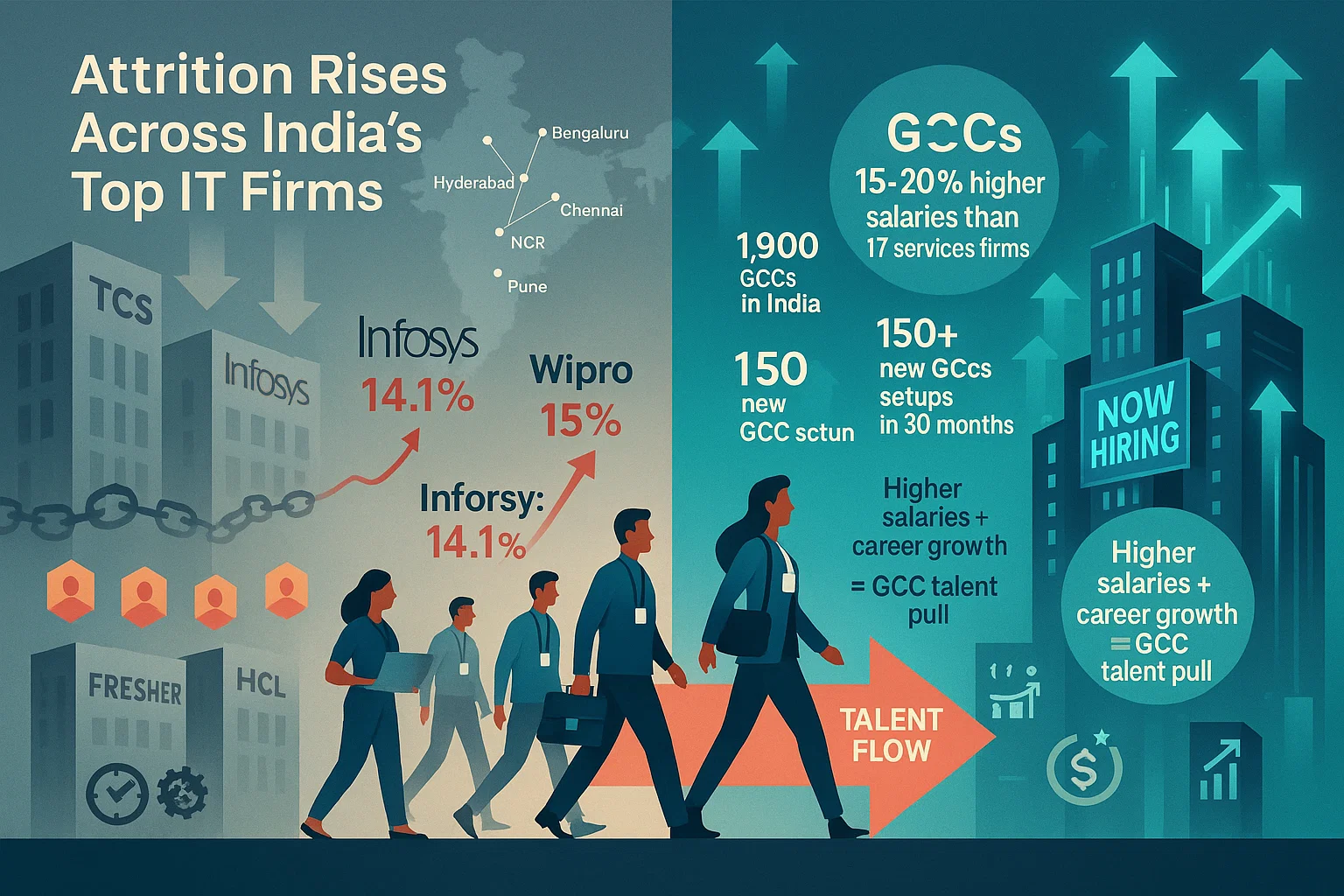
    According to a report by The Hindu Business Line, attrition rates have increased across these companies, with Infosys witnessing a rise to 14.1% and Wipro’s attrition rate reaching 15% in FY25.

    Global Capability Centres are offshore centres set up by multinational companies to leverage India’s talent pool and cost advantages. These centres have been increasingly popular in India, with nearly 1,900 GCCs currently operating in the country, including around 150 new setups in the last 30 months. GCCs are known to offer higher salaries, with 15-20% more than what IT companies typically offer, making them attractive to professionals, especially those with less than five years of experience.

    Attrition Impact on IT Companies

    To mitigate the impact of rising attrition, IT companies are expected to hire more freshers this year. Infosys’ CFO, Jayesh Sanghrajka, noted that attrition is influenced by multiple factors, including opportunities outside the company, competition, and employees pursuing further studies. The increased competition from GCCs is putting pressure on IT companies to retain talent.

    Industry Outlook

    The Indian IT industry is navigating a challenging landscape, with muted revenue growth expected in FY25. According to a report by CRISIL Ratings, the top four IT companies will see 5-7% year-on-year revenue growth in FY25, marking the second successive year of muted growth. Despite these challenges, the industry is expected to inch up to 6% growth in FY25, driven by increased operating efficiencies .

    Key Attrition Rates for Top IT Companies

    • Tata Consultancy Services (TCS): 13.3% in FY25, up from 12.5% in FY24
    • Infosys: 14.1% in FY25, up from 12.6% in FY24
    • Wipro: 15% in FY25, up from 14.2% in FY24
    • HCL Technologies: 13% in FY25, up from 12.4% in FY24