Tag: GCC India

  • TCS Independent Director Keki Mistry Sees Value in Partnering with India’s GCCs

    TCS Independent Director Keki Mistry Sees Value in Partnering with India’s GCCs

    IT and software-services companies should proactively explore ways to collaborate with Global Capability Centres (GCCs) in India, as there can be significant value in partnering with these centres to deliver high-quality services to clients, Tata Consultancy Services (TCS) Independent Director Keki Mistry has said.

    Speaking at the company’s annual general meeting last week, Mistry noted that while inflation would impact wage bills and the general cost of living and doing business, TCS has been able to mitigate the effects.

    Mistry also addressed concerns about the impact of artificial intelligence (AI) on jobs, stating that while AI may automate some tasks, it would also unlock new efficiency opportunities

    Regarding Global Capability Centres (GCCs) in India, Mistry said that company clients continue to see significant value in partnering with TCS. He added that the company is working on engagement models to collaborate with GCCs, which have become an integral part of the Indian IT industry.

    GCCs, which are internal IT departments set up by multinational companies in India, have become a crucial part of the country’s IT industry. India has emerged as a hub for GCCs, with many major companies setting up operations in the country to leverage its skilled workforce and favourable business environment.

    Mistry’s comments highlight the growing importance of GCCs in the Indian IT-services industry and the opportunities they present for companies like TCS. By working with GCCs, TCS can tap into their expertise and capabilities to deliver innovative solutions to clients.

    The development comes as TCS continues to navigate the challenges of high inflation and the impact of AI on jobs. According to Mistry, while AI may automate some tasks, it will also unlock new efficiency opportunities. The company has effectively managed the impact of persistent high inflation on its business through improved productivity and operational efficiencies.

  • How Generative AI is Rewiring the Role of India’s Global Capability Centres

    How Generative AI is Rewiring the Role of India’s Global Capability Centres

    India’s Global Capability Centres (GCCs) have long been heralded as back offices-turned-centres of excellence, now numbering over 3,000, employing nearly 1.9 million professionals, and contributing more than US$65 billion annually. But those figures are beginning to feel fragile. With generative AI tearing through global value chains, GCCs—once celebrated for their scale and efficiency—now face an urgent question: what exactly is their role in a world where intelligent systems can replace entire workflows?

    AI is not simply another productivity tool layered onto legacy structures. It represents the dismantling of those structures altogether. Tasks that previously took days – compliance reviews, code refactoring, and user testing – are now completed in minutes. In the first quarter of 2025, demand for GenAI-related roles within GCCs rose by over 30% year-on-year. But this is not a hiring boom—it is a skills pivot. The platforms that once thrived on predictable, repeatable tasks now face redundancy not through layoffs but through irrelevance. The work is disappearing. And the operating model must evolve before it does, too.

    Inside the AI Engines That Outgrew the Back Office

    Look closely, and the contours of the next-generation GCC are already beginning to take shape. JPMorgan’s GCCs in India are no longer passive extensions of their global headquarters. Today, they power more than 400 AI-enabled applications spanning fraud detection, risk scoring, marketing intelligence, and digital banking. The firm’s proprietary CodeWhisperer-style assistant is reportedly boosting engineering productivity by 10%–20%, enabling developers to focus on high-leverage innovation. That’s not a minor efficiency gain; it’s a fundamental shift in creating value.

    Walmart Global Tech provides another compelling example. Its internal AI assistant ecosystem has saved over four million developer hours globally, much of that anchored in India. One such tool, Wallaby, a large language model developed in-house, now powers critical internal workflows, including inventory forecasting, last-mile logistics, and policy guidance. Wallaby doesn’t merely assist; it makes decisions. The India GCC is not a satellite; it is the central nervous system.

    Honeywell, long seen as a legacy industrial player, tells a similar story. Its India operations have quietly become the backbone of its global software ambitions. Over 60% of Honeywell’s software engineers are now based in India. The Forge AI platform, significantly developed in Bengaluru, is a key driver of its aviation and energy efficiency solutions. Honeywell India is expected to cross US$1 billion in annual revenue by the end of this year. The work conducted there is no longer transactional—it is foundational.

    Still, for every success story like JPMorgan or Walmart, there are dozens of GCCs trapped in outdated models—measuring success by SLA compliance, not product shipped; by full-time equivalents, not patents filed. A recent BCG study revealed that only 8% of India’s GCCs have matured into genuine innovation hubs. The rest remain in a holding pattern—proficient at doing more for less, yet unclear on how to do things differently.

    There’s a cultural and skills dimension to this, too. GenAI proficiency is not about prompt engineering alone—it requires a mindset shift. Engineers must now think like product owners. Designers must understand model limitations. Managers must prioritise outcomes over processes. And yet, AWS-backed research shows that while 64% of Indian enterprises view GenAI as a strategic priority, 75% lack any formal change management strategy to implement it. The gap isn’t technical—it’s imaginative.

    Two Paths: Automated Obsolescence or AI-Catalysed Reinvention

    India’s GCCs are approaching a fork in the road. One path is to continue chasing cost efficiency and headcount growth—a race they are unlikely to win against increasingly intelligent systems. The other is to reimagine themselves as creators of original, enterprise-grade value.

    This transformation begins with redefining success. GCCs must no longer be measured solely by operational metrics. They need to be evaluated by the quality of IP created, the commercial outcomes delivered, and the platforms and tools they design. Teams must evolve into cross-disciplinary pods—bringing together product managers, AI experts, domain specialists, and designers—to build, not just deliver. And GCC leaders must transition from operations managers to intrapreneurs, capable of owning charters, taking strategic bets, and being accountable for outcomes, not just inputs.

    Encouragingly, some systemic support is emerging. Uttar Pradesh’s GCC policy aims to create over 200,000 high-paying jobs, not just by offering plug-and-play real estate, but potentially by enabling IP-sharing models and structured AI testing zones. If executed well, such initiatives could help position GCCs as part of India’s enterprise innovation architecture, not as outsourcing footnotes.

    Still, policy can only enable. The real shift must come from within. Enterprises must begin to view their GCCs as strategic partners, not delivery arms. Boards must grant them the autonomy to invent, not just execute. India has a rare combination: depth in STEM talent, adjacency to global enterprises, a maturing start-up ecosystem, and the trust of Fortune 500 boardrooms. If these forces are brought into alignment, GCCs could become the crucibles where the next generation of AI-native business systems are imagined, built and scaled.

    But none of this is guaranteed. Organisational inertia is a formidable opponent. Metrics calcify. Structures resist change. And the temptation to cling to what has always worked is often strongest just before it stops working.

    The AI wave will not destroy India’s GCCs. But it will remake them decisively and comprehensively. Those that fail to adapt may not be replaced by competitors but rendered redundant by the systems they helped build. Yet those who lean in—who reframe their identity from execution engines to originators of enterprise innovation—stand to become foundational to the future of global business.

    India’s GCCs sit at a powerful intersection: talent, trust, and technological transition. With the right ambition and investment, they can transcend their original mandates. No longer cost centres or code factories—but global command centres for enterprise AI, product innovation, and value creation. This is not the twilight of a model. It is the dawn of a new mandate—if we choose to see it that way. 

    In a world where machines are learning to think, what must we unlearn to stay relevant?

  • How Nordic Firms are Using their India GCCs to Chase Innovation

    How Nordic Firms are Using their India GCCs to Chase Innovation

    While American firms dominated India’s Global Capability Centre (GCC) landscape with more than two-thirds of office leasing activity in 2024, Nordic companies, by contrast, are steadily and strategically growing their presence, investing in long-term innovation capabilities. Reason? India’s vast and highly skilled tech workforce, AI, data analytics and engineering capabilities and a cost advantage of up to 40% compared to Eastern Europe.

    A recent report by Nasscom reveals that case studies of Nordic companies show how these firms leverage India’s readily available tech talent and ecosystem to accelerate innovation and enhance global responsiveness. For example, Ericsson’s Bengaluru GCC, specialising in 5G and AI-driven telecom R&D and Nokia’s Noida center, focused on network infrastructure and IoT, highlight how both companies have utilised India’s capabilities to anchor global R&D, product development, and digital transformation.

    Over the last few years, the GCC facilities of Nordic firms, equipped with state-of-the-art testing environments, have become central to their global innovation roadmaps. 

    Drawing on India’s engineering talent and urban infrastructure boom, it’s here that cutting-edge safety algorithms, digital control systems and sustainability enhancements are engineered before they debut worldwide. 

    Besides India’s talent pool of over 500,000 IT engineers and a thriving startup ecosystem specialising in technologies such as AI, IoT, edge computing, and smart connectivity—which align with Nordic priorities in telecom, sustainable tech, and other core areas—the country’s fast-growing economy also offers Nordic firms a strategic gateway to other emerging Asian markets. 

    The Nasscom report titled “Nordic Companies Leveraging Global Capability Centers in India” points out that collaborations like the India-Sweden Innovation Partnership and Nordic summits have deepened ties between the regions. Initiatives like the Joint Declaration on Innovation Partnership for a Sustainable Future foster cooperation in smart cities, green energy, digitalisation, and health sciences—creating a robust environment for innovation-led GCCs.

    With India’s deep expertise in IT, AI, analytics, and engineering, and its alignment with Nordic values of innovation and sustainability, an increasing number of Nordic companies are choosing India to establish their GCCs. These centres now serve as brain trusts, driving not just back-office operations but cutting-edge research, digital transformation, and product innovation for global markets.

    With over 1,700 GCCs in India, employing approximately 1.9 million professionals and generating more than US$64 billion in exports, GCCs are becoming strategic innovation partners for global corporations. The GCC sector in India is expected to grow beyond US$100 billion by 2030. 

    However, despite the GCC boom, Nordic companies face their share of challenges while operating in India. Cultural differences create communication gaps and misaligned expectations due to contrasting work styles. Additionally, India’s complex regulatory framework around foreign direct investment policies, labour laws, taxation, and compliance, can be daunting. Establishing dedicated compliance teams helps ensure timely adherence to policies and anticipates regulatory changes. Early and thorough due diligence before entering new markets can further reduce risks associated with regulatory complexity, noted the Nasscom report, adding that by 2030, Norway and Iceland are expected to set up GCCs in India.

    The report further highlights that while Norway may focus on maritime and energy technologies, Iceland could develop green-tech facilities. Sweden’s success in automotive and telecom GCCs will serve as a model, encouraging more Nordic collaboration. 

    The ramping up of GCCs by Nordic firms reflects a strategic shift: from viewing India as a cost-effective support base to recognising it as an innovation hub driving global strategies.

  • New Global Hub at Bengaluru Airport City to Boost Tech Innovation

    New Global Hub at Bengaluru Airport City to Boost Tech Innovation

    The Karnataka government, Bengaluru Airport City Ltd. (BACL), and ANSR have launched a Global Innovation Hub, District I, at Bengaluru Aerocity. The hub within BACL’s Business Park, aims to foster innovation in industries such as artificial intelligence, quantum computing, blockchain, and customer experience technologies, among others.

    It is part of the Phase 1 development of the aerocity, which will feature various hubs for research and development, education, health, business, and entertainment.

    The launch of District I is expected to further establish Bengaluru as a leading innovation hub in India. The city already hosts over 16,000 startups, 50% of India’s unicorns, more than 550 Global Capability Centers (GCCs), and a vast pool of skilled, future-ready tech professionals. Moreover, India’s GCC industry is projected to reach US$110 billion by 2030, creating millions of jobs and driving significant economic growth.

    According to Lalit Ahuja, Founder & CEO of ANSR, the launch of District I will “by uniting startups, service providers, GCCs, academia and public infrastructure on one seamless platform, we are setting a powerful flywheel in motion that will propel the next wave of breakthrough technologies from India to the world”.

    The new centre is poised to support India’s growing reputation as a global leader in innovation and technology. It will serve as a launchpad for startups, a commercialisation engine for academic research and a co-innovation platform for enterprises. 

    The hub will feature an Innovation and Research District that includes the Bengaluru International Convention Centre (BICC), office and workshop spaces, a design institute, and a life sciences park. It will also have a Business District with business parks and corporate offices. A MICE and Retail District will provide spaces for meetings, incentives, conferences, and exhibitions. It will also include retail and entertainment venues such as malls and concert venues. Additionally, a Design and Culture District will focus on creative industries and cultural activities.

  • From Back Office to Backbone: The Rise of GCCs in India

    From Back Office to Backbone: The Rise of GCCs in India

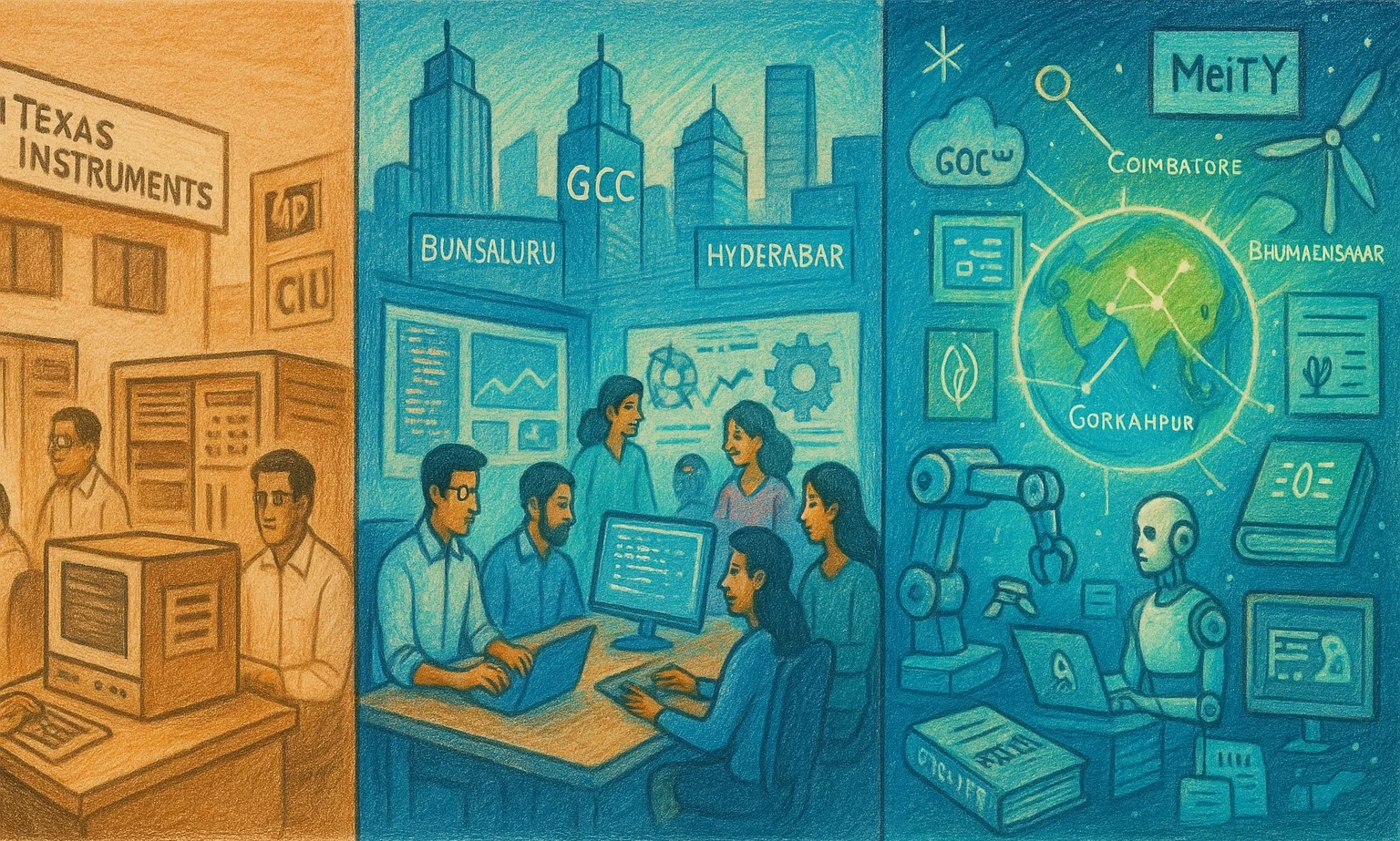
    Back in 1985, a little-known move by Texas Instruments in Bengaluru set off a chain reaction no one quite foresaw. The American tech company wasn’t here to outsource or to save money. It was here to build. It was here for talent. 

    What started as a modest experiment with a group of talented engineers turned into a global innovation hub for the tech major in the years to come.

    Other global giants took notice — Citicorp, Hewlett-Packard and others. They too set up what were then called ‘captive centres,’ little more than extended arms of their global operations, mostly handling IT support or finance processing.

    But what began as a cost-saving exercise soon turned into something far more strategic. India was changing—and fast. The 1990s brought sweeping economic liberalisation, opening the doors to foreign investment. As the century turned, multinationals saw the opportunity not just to cut costs — but to create value. 

    After the early 2000s, the captive centres mushroomed rapidly in India. Global corporations realised that it is not just about low-cost workforce but the capability that exists in the country in terms of manpower, knowledge and skills can easily drive high-tech projects for them at an offshore location.

    They started giving their Indian teams more complex work. Instead of simply processing payroll or maintaining IT infrastructure, these centres were suddenly handling software development, analytics, risk modeling, even product design. The term “captive centre” quietly faded, and a new one took its place: Global Capability Centre, or GCC.

    By 2020, India had thousands of GCCs, with cities such as Hyderabad, Pune and Chennai joining Bengaluru in hosting these key centres of productivity and innovation. Global corporate titans were creating strategies out of India.

    And it hasn’t slowed down.

    According to the Ministry of Labour & Employment, as of early 2024 India hosted over 1,700 GCCs, collectively employing 1.9 million professionals and generating US$64.6 billion in annual revenue.

    A number of factors have fueled India’s growth in this sector. The country has long benefited from a large pool of cost-effective, English-speaking talent in engineering and research. Government support has also played a crucial role, with both central and state policies helping to create a highly attractive investment climate for GCCs. This includes national tax breaks, SEZ benefits and state-level efforts to attract global companies.

    In 2025, the Ministry of Electronics and Information Technology (MeitY) launched a national initiative to create a formal framework for supporting and expanding GCCs. The aim is clear: streamline policies, encourage investment, and ensure that India remains the first choice for global firms looking to set up strategic operations.

    Interestingly, the landscape is shifting geographically, too. While Bengaluru remains the heart of the movement, tier-2 cities are increasingly pulling their weight. Cities such as Coimbatore, Bhubaneswar, and Vadodara are attracting serious interest. State governments are stepping in with incentives, making the pitch that these smaller cities offer talent without the traffic or real estate costs.

    Take Uttar Pradesh, for example. It recently launched a dedicated GCC policy, encouraging companies to invest not just in Noida, but in Varanasi, Kanpur, and Gorakhpur as well. The vision is to create jobs, stimulate local economies, and distribute growth beyond metro boundaries.

    The trajectory from 1985 to now has been impressive—but what’s ahead might be even more compelling. Projections suggest that by 2030, India could host as many as 2400 GCCs. The demand is being driven by new waves of technology—artificial intelligence, automation, clean energy, climate-tech — and global businesses are increasingly leaning on India not just to support these innovations, but to lead them.

    There was a time when the phrase “back office” was almost synonymous with India. Today, it’s more accurate to say that India is the nerve centre of the global enterprise. The country has positioned itself not just as an execution partner—but as a strategic driver of the digital economy.

    And that journey is far from over.

  • Global Capability Centres in India Shift from Service Delivery to Innovation Hubs: Mohit Sood of ZS

    Global Capability Centres in India Shift from Service Delivery to Innovation Hubs: Mohit Sood of ZS

    Global Capability Centres (GCCs) in India are evolving from service delivery-focused operations to innovation hubs, according to Mohit Sood, Regional Managing Principal at ZS, in an interview with Data Quest

    With over 1,700 GCCs in India, employing approximately 1.9 million professionals and generating more than US$64 billion in exports, these centres are becoming strategic innovation engines for multinational companies. The shift to innovation hubs involves solving complex problems using R&D, emerging tech and cross-functional collaboration, adding strategic value beyond efficiency-driven service delivery.

    ZS helps organisations build and scale innovation-led GCCs by developing business cases, transition plans, and success metrics, and enabling this shift through GCC-as-a-service models, tech-driven transformation, and innovation labs. For mature GCCs, ZS offers Build-Operate-Transfer and Enable models, supported by AI platforms like ZAIDYN and (link unavailable) and skilled talent augmentation. This approach enables GCCs to drive innovation and growth, while also improving efficiency and reducing costs.

    India’s vast skilled talent pool in data science, technology and analytics, along with its time zone advantage for seamless collaboration with global clients, makes it an attractive location for GCCs.

    The country’s globally aware professionals with diverse industry exposure also contribute to the growth of innovation hubs. ZS’s experience in India demonstrates the potential for GCCs to drive innovation in areas like AI-driven drug discovery and digital health.

    The company’s India centre is at the forefront of global transformation, leveraging the country’s scale, talent and innovation to develop high-impact AI expertise and scalable solutions. With a strong focus on innovation and entrepreneurship, ZS is contributing to India’s evolving tech landscape and helping establish the country as a hub for global innovation.

  • Inside Indian States’ Push for a Bigger Slice of the GCC Pie

    Inside Indian States’ Push for a Bigger Slice of the GCC Pie

    This January, a striking new chapter unfolded at the World Economic Forum in Davos. Eight Indian states – Kerala, Telangana, Uttar Pradesh, Andhra Pradesh, Maharashtra, Tamil Nadu, Karnataka, and West Bengal, came armed with a singular mission: to pitch themselves as the next big hub for Global Capability Centers (GCCs). The result? A staggering ₹20 lakh crore (US$231 billion) in investment commitments and a clear signal: India’s GCC race is no longer just national–it’s hyper-local and competitive.

    But the buzz didn’t end in the Swiss Alps. Back home, the momentum only grew. State governments rolled out GCC-friendly policies, making one thing clear: the GCC battleground is now at the state level.

    With more than 1,800 centers generating US$64.6 billion in revenue in 2024 and projections to cross US$100 billion by 2030, according to the 2024 GCC Annual Report by NASSCOM, the sector has evolved dramatically. No longer confined to back-office functions, GCCs now sit at the heart of global strategy, driving R&D, product engineering, and innovation. Over 364,000 new jobs are expected by 2025. And this time, states want their share of the pie.

    The Policy Blitz Begins

    Karnataka was the first off the blocks with a dedicated GCC Policy (2024–2029), laying out bold targets, 500 new centers, US$50 billion in output, and 3.5 lakh new jobs. The policy includes rental subsidies, innovation lab support, and skilling reimbursements.

    Hot on its heels, Uttar Pradesh rolled out its own vision with its GCC Policy 2024. It hopes to add 200,000 high-paying jobs by attracting GCCs to Noida, Lucknow, and Varanasi. With a clear eye on becoming a US$1 trillion economy, UP’s policy outlines frameworks for both entry-level and advanced centers.

    Andhra Pradesh’s GCC & IT Policy 4.0 aims to bridge infrastructure gaps and spread employment across tier-2 cities. Gujarat has joined in with a 2025–30 strategy that highlights digital transformation and high-value services. Even Madhya Pradesh, not traditionally seen as an IT hub, has entered the fray with a globally benchmarked policy aiming to plug into India’s projected US$110 billion GCC future.

    Tier-2 Cities: The New Frontier

    One of the more interesting trends is the pivot to smaller cities. Nasscom’s India GCC Landscape report, published in September last year shows GCC presence in tier-2 and tier-3 locations is expected to grow by 15–20% by 2025, with longer-term projections closer to 30%. Cities like Jaipur, Vadodara, Kochi, and Bhubaneswar are becoming viable alternatives to congested metros, offering lower costs, better quality of life, and untapped talent.

    States are keen to capitalise. By incentivising GCC expansion in these cities, governments can address urban saturation while driving localised economic transformation. Experts at Inductus predict job demand in these regions could spike by 30%–40% over the next two years.

    A Centre-State Balancing Act

    The central government, too, is taking note. MeitY is reportedly working on a national GCC policy that would complement state-level efforts and push for deeper expansion into smaller towns, especially for niche sectors like healthcare and fintech.

    But this patchwork of policies isn’t without issues. Analysts from Inductus Consulting warn that the lack of standardisation makes it harder for global firms to navigate India’s regulatory landscape compared to more coordinated ecosystems like Singapore or Ireland. Infrastructure remains another sore spot. While ambition is high, execution, particularly in tier-2 cities, lags behind in connectivity, power, and institutional support.

    India’s dominance, though formidable, isn’t guaranteed. Countries like Poland, Vietnam, and the Philippines are quietly gaining ground, offering leaner regulations and tailored incentives. To stay ahead, India must go beyond fiscal SOPs and focus on long-term capability building.

    What Lies Ahead

    The real challenge lies in coordination. Without better synergy between state ambitions and national frameworks, there’s a risk of duplication, inefficiency, and policy fatigue. States need to invest in infrastructure, skilling, and innovation ecosystems – not just the incentive sweeteners.

    India’s GCC story is at an inflection point. The inter-state competition is a healthy sign of decentralised ambition, but it needs guardrails. The future will belong not to the states that offer the deepest subsidies, but to those that can build sustainable ecosystems – ones that combine talent, technology, and trust.

    If India can align its central and state strategies while moving from transactional incentives to transformative infrastructure, its position as the world’s GCC nerve centre could be unshakeable.

  • India’s GCCs Face Talent Crunch as Demand Outstrips Supply: Report

    India’s GCCs Face Talent Crunch as Demand Outstrips Supply: Report

    A looming talent gap threatens to impede the growth of India’s Global Capability Centres (GCCs), with demand for skilled professionals expected to surpass supply in the coming years, highlights a recent report by People Matters, titled “GCC India Talentscope 2025. According to the report, 9 out of 10 GCC leaders believe that talent demand will exceed supply by 2030, with India’s GCC landscape expected to support a US$100+ billion market and employ over 4.5 million professionals.

    The report emphasises the importance of artificial intelligence (AI) and machine learning (ML) optimisation, with 59% of leaders prioritising it as a top technical skill, particularly in financial services (68%) and IT/tech (55%) sectors. 

    In terms of hiring innovations, 47% of leaders use AI-driven hiring platforms, while 21% champion skill-based hiring and 15% build broader talent ecosystems. For upskilling strategies, 60% favor cross-industry learning, 59% support personalised learning platforms, and 42% choose immersive tech and mentorship.

    To address the talent gap and drive growth, the report outlines three critical imperatives for GCCs: scaling intelligent digital infrastructure by building a data-rich, cloud-native, and AI-integrated stack; cultivating external knowledge networks by collaborating with startups, universities, and sector peers to drive innovation; and operationalising talent analytics by using talent data to shape real-time decisions and drive business outcomes. 

    By prioritising talent development, strategic workforce planning, and intelligent digital infrastructure, GCCs can position themselves for success in the next decade.

    The report points out that India’s GCCs will not succeed on volume alone; capability is the real game-changer. GCCs that prioritise talent development, strategic workforce planning, and intelligent digital infrastructure will be best positioned to lead in the next decade.

  • Toyo and MODEC Open Global Capability Centre in Bengaluru

    Toyo and MODEC Open Global Capability Centre in Bengaluru

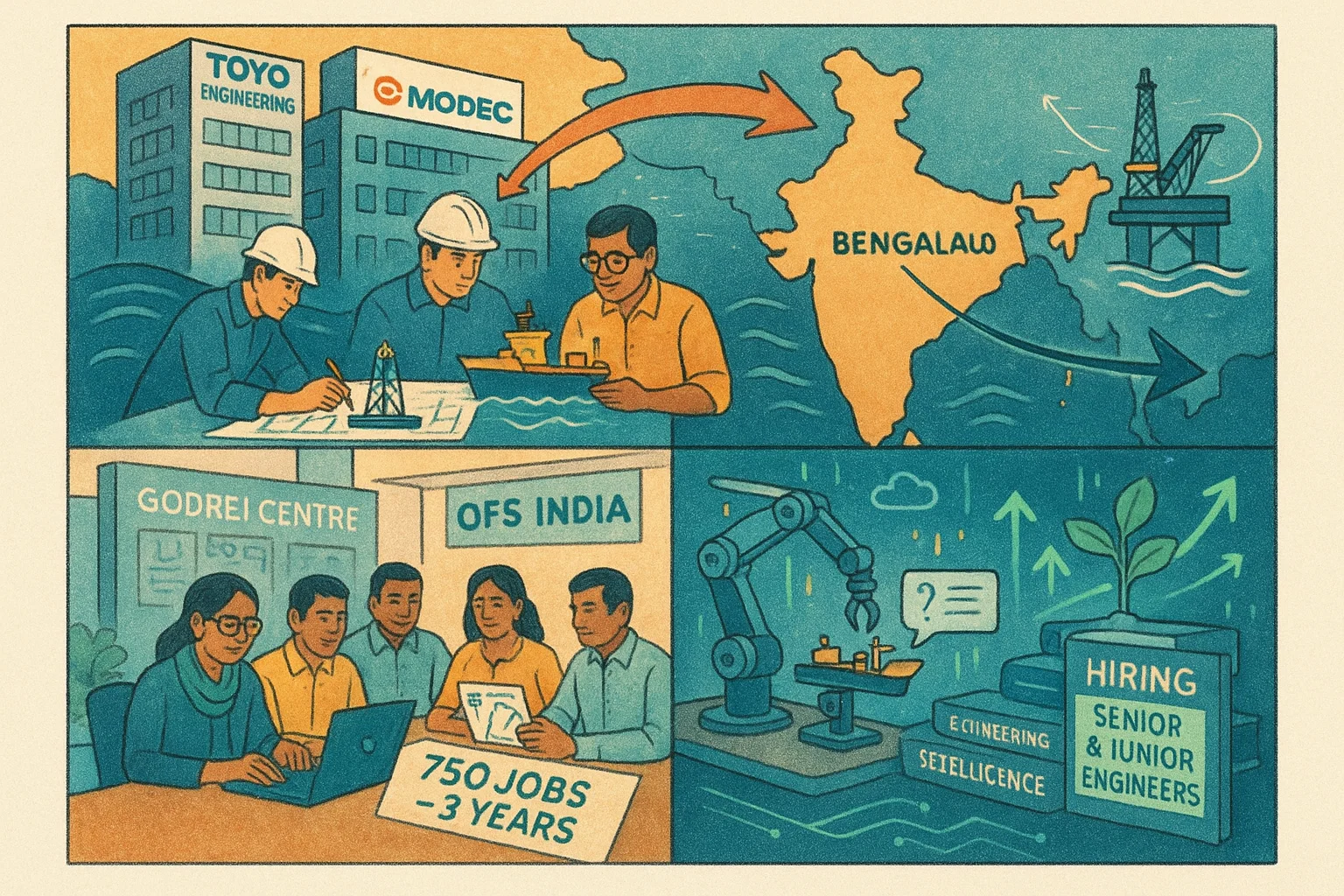
    Toyo Engineering Corporation (Toyo Japan) and MODEC, Inc. (MODEC) have officially opened their Global Capability Centre (GCC), TOYO MODEC OFS India Private Limited (OFS India), in Bengaluru, India. The new centre is a joint venture between Toyo India and Offshore Frontier Solutions Pte. Ltd. (OFS), a MODEC) and is designed to enhance the companies’ ability to deliver innovation, operational excellence, and scalable services across international markets.

    The GCC is located in the heart of Bengaluru, India’s Silicon Valley, and occupies approximately 100,000 sq ft on the 7th floor of Godrej Centre Indiranagar.

    The centre is set to create numerous high-value job opportunities in engineering, procurement, and comprehensive support for Floating Production Storage and Offloading (FPSO) projects, with plans to expand its local workforce to 750 within the next three years.

    The GCC is designed to nurture a collaborative, high-performance culture with a focus on innovation, sustainability, and continuous improvement.

    The new centre marks a significant milestone in the companies’ global growth strategy, enhancing their ability to deliver innovation, operational excellence, and scalable services across international markets.

    Takashi Kawahara, Managing Director of Toyo India and Chairman of OFS India, said: “The GCC in Bengaluru will serve as a strategic hub to support global projects, enhance engineering capabilities, and drive digital transformation. It also represents our long-term commitment to India, generating hundreds of high-quality job opportunities and contributing to India’s emergence as a global engineering and innovation centre.”

    Kawahara further added: “We still need to hire many more people, especially those with experience, skills, and talent. So, we are looking for senior engineers, but also for junior engineers who can grow with us.”

  • Episode 11: GCCs in the Spotlight – Latest Trends and Updates

    This episode explores the recent developments shaping the future of Global Capability Centres in India. Tune in for the key takeaways on:

    • AstraZeneca India’s strategic framework prioritising skill-based growth, inclusivity and technology-driven HR processes;
    • Publicis Sapient’s new GCC transformation focus area enabling enterprises to build, scale and transform their GCCs; 
    • First Citizens BancShares’ expansion in India reinforcing the country’s role as a premier hub for GCCs; 
    • Infosys’ new Development Centre in GIFT City, Gandhinagar;
    • Quess Corp’s new business line supporting global enterprises in setting up capability centers. Lastly a report highlighting a looming talent gap threatening GCC growth, with 9 out of 10 leaders expecting demand to surpass supply by 2030. 

    Listen now to stay ahead!