Tag: GCC India

  • India-based GCCs emerge as global hubs for complex tax operations: Deloitte

    India-based GCCs emerge as global hubs for complex tax operations: Deloitte

    India-based Global Capability Centres (GCCs) have become strategic hubs for multinational companies to manage complex global tax operations, according to a Deloitte whitepaper report. These centres offer a unique blend of expertise, technology, and cost efficiency, making them an integral part of the global tax ecosystem.

    The report, titled “Transforming Global Tax Functions: The GCC Advantage,” highlights the growing significance of India’s GCC landscape, with over 1,700 GCCs employing 1.9 million professionals and generating $64.6 billion in revenue as of 2024. These centres are increasingly being used to handle complex tax operations, including corporate tax, indirect tax, transfer pricing, and litigation.

    The Deloitte whitepaper report highlights key findings that showcase India’s growing importance in enterprise tax transformation, with 76% of participants already undertaking global tax processes from India, underscoring the country’s expertise and capabilities in handling complex tax operations. 

    GCCs in India are transitioning from data processing to knowledge processing, with a significant shift towards diversification of operations and evolution towards higher-value services, driven by the country’s expertise, technology, and cost efficiency. 

    India is home to key GCC hubs, including Bengaluru, Hyderabad, Pune, Chennai, Mumbai, and the National Capital Region (NCR), making it an attractive destination for global players. The sector is projected to expand to $105 billion by 2030, with around 2,400 GCCs employing over 2.8 million people, solidifying India’s role as a global hub for enterprise operations and innovation

    The whitepaper notes that GCCs have become a crucial part of the global tax ecosystem, providing organizations with a competitive edge in managing their tax functions. As more organizations pursue centralizing tax functions, many have already established tax Centres of Excellence (CoEs) in India.

    The growth of GCCs in India is driven by the country’s expertise, technology, and cost efficiency, making it an attractive destination for global players. With 40% of digital transformation projects in GCCs, India is now a centre for high-value technology-driven solutions.

  • How GCCs are Building a Culture That Works for All

    How GCCs are Building a Culture That Works for All

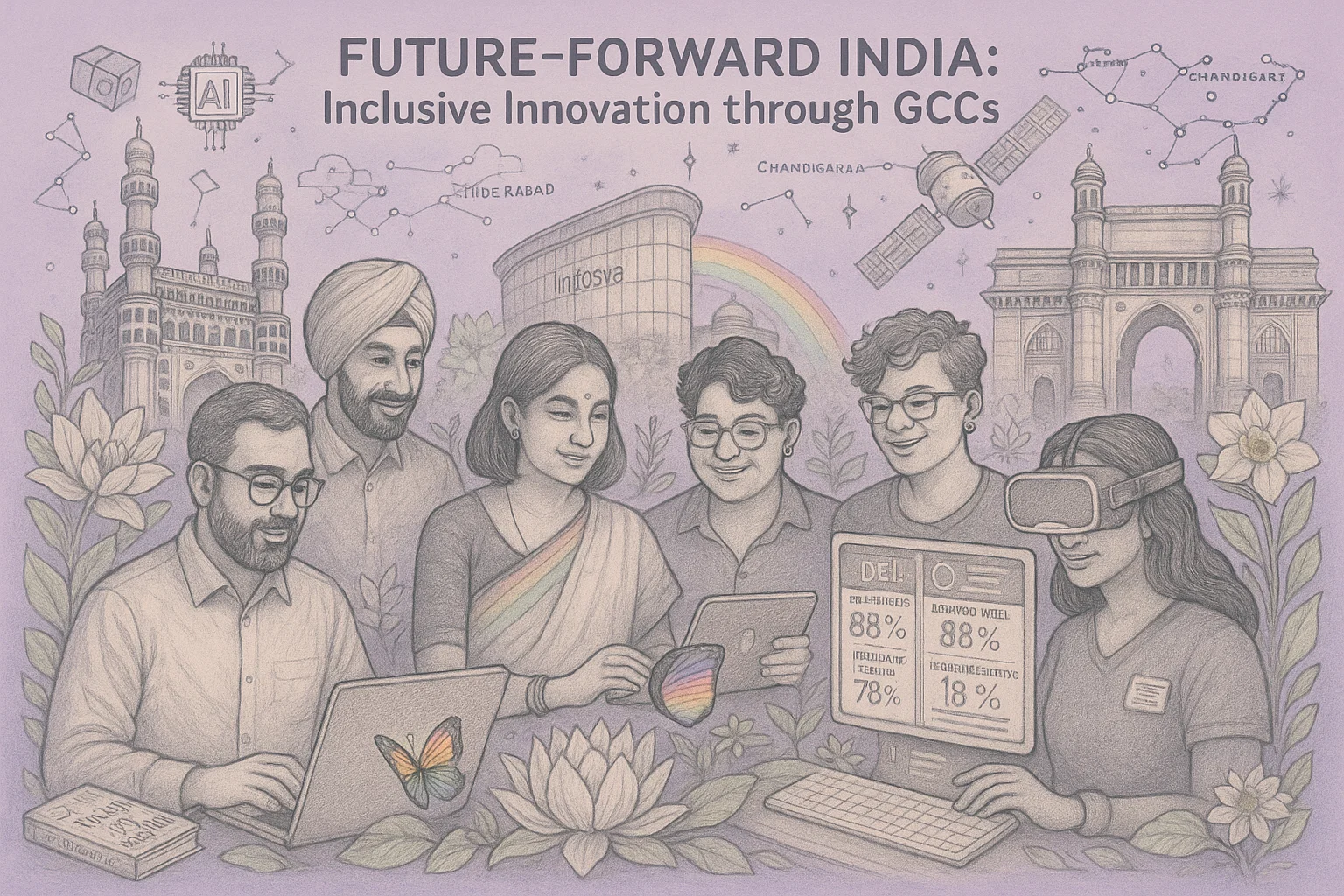
    This June, as Pride Month infuses cities around the world with vibrant celebration and visible advocacy, a quieter yet equally powerful transformation is unfolding in India. Beyond the parades and public displays, there’s a shift happening within the boardrooms and hallways of India’s Global Capability Centres (GCCs).

    Traditionally seen merely as hubs of technology, data, and operational efficiency for multinational corporations, these centres are now taking on a deeper, more profound role as active pioneers of social and cultural change. Led by organisations like EY India, whose recent Pride Month initiative (aptly titled “Strengthening Every Step”) highlights intentional and authentic inclusion, GCCs are demonstrating that genuine LGBTQIA+ representation requires sustained, systemic commitment beyond symbolic gestures.

    This moment marks a quiet evolution — where India’s GCCs are not merely observers but active drivers embedding true diversity, equity, and inclusion into the very fabric of corporate culture.

    From Codes to Culture

    Just a decade ago, India’s GCCs operated largely under the radar, seen as cost-efficient back offices supporting global operations. These centres were primarily evaluated on productivity and scalability, not cultural leadership. Organisational identity was often an extension of headquarters, and efforts around diversity and inclusion were minimal, with most programmes confined to gender diversity or periodic sensitivity training. Conversations around LGBTQIA+ inclusion, in particular, were nearly nonexistent, mirroring broader societal discomfort and the legal ambiguity that prevailed in India at the time.

    That began to shift significantly after the 2018 landmark Supreme Court judgment decriminalising Section 377. This legal recognition acted as a catalyst, opening the door for global companies to align their Indian operations with inclusive international values. GCCs — which had already grown in size, capability, and strategic importance — suddenly found themselves under a different kind of spotlight: one that demanded cultural congruence, not just cost competence.

    Time for Action

    Driven by a mix of global DEI frameworks, leadership accountability, and a rising wave of employee expectations, inclusion has moved from the periphery to the centre of GCC strategies. And with that, Pride Month in India has taken on a very different tone—not just as a symbol, but as a reflection of year-round commitment and structural reform.

    Take GSK India, for instance, where their “Spectrum” Employee Resource Group has matured from annual Pride celebrations into a year‑round movement. According to their 2024 ESG report, inclusion forms one of six core pillars, assessed through employee surveys (81 % favourable score) and governed by country‑based pay‑fairness reviews. Also in 2024, GSK hosted a full-scale Pride march at their Bangalore GCC, accompanied by events like “Breaking the Bias” and “Rainbow Reflections”, and even a recruitment drive aimed at LGBTQIA+ professionals.

    And then there’s EY India, whose inclusive ethos—declared in both global DEI statements and local “Belonging Barometer” research—culminates in their “Strengthening Every Step” campaign. This isn’t just gingerbread flair for June; it’s part of a strategic continuity plan backed by leadership commitments and senior role models. In FY24, multiple EY professionals were included in the OUTstanding LGBTQ+ Role Model lists. Workplace inclusion here is a core performance lever, not an annual afterthought.

    Even with such progress, the road to equity is far from over. Publicly available data points to the fact that India continues to face stubborn gaps in representation — women hold only around 23% of permanent roles, with tech and consumer services leading at ~34%. When it comes to LGBTQIA+ inclusion, the data is even more sparse, often invisible within corporate reporting. But that lack of data doesn’t imply lack of presence — it reflects the ongoing need for courageous visibility and institutional support.

    Change is Afoot 

    And yet, not all is lost. Change is not only possible—it’s already unfolding. What we’re seeing in India’s GCCs is not just a culture shift—it’s a blueprint. A model for how operational centres can become transformation engines. By embedding LGBTQIA+ inclusion into business strategies, leadership scorecards, and daily behaviours, these organisations are proving that equity doesn’t slow down performance; it powers it.

    As the Pride flags come down at the end of June, what will matter most is what stays up — policies, protections, pipelines, and pride that lives beyond a month. Because the measure of inclusion is not visibility in moments of celebration, but continuity in moments of silence.

    GCCs have the reach, the resources, and increasingly, the resolve to lead this charge—not just within their organisations, but across India’s corporate landscape. In doing so, they’re not only strengthening every step—they’re setting the pace.

  • It’s Now Or Never: What Indian GCCs Need To Become Innovation Powerhouses

    It’s Now Or Never: What Indian GCCs Need To Become Innovation Powerhouses

    In late 2022, a Fortune 500 consumer goods company quietly transferred full ownership of a digital trade promotion platform to its India-based Global Capability Center (GCC). The mandate was simple: build, launch, and scale across key ASEAN markets. Nine months later, the platform went live, with 30% lower development cost, three weeks ahead of schedule, and several feature adaptations uniquely suited to the local market. None of these innovations had been envisioned at headquarters. They were the product of proximity, autonomy, and ownership.

    This is what happens when a GCC stops executing and starts leading.

    And yet, such stories remain the exception. Despite employing over 1.5 million highly skilled professionals and managing increasingly complex mandates from AI development to global platform rollouts, most GCCs remain on the margins of strategic decision-making. They build. They optimise. But they rarely lead.

    The gap isn’t in capability. It’s in control.

    Many global firms celebrate their GCCs in public, yet behind the scenes, those same centers are denied ownership of products, budgets, or market-facing decisions. They are expected to execute against predefined problem statements, meet delivery SLAs (service level agreements), and occasionally participate in innovation sprints but not define roadmaps, shape strategies, or take P&L accountability. This disconnect between intent and institutional design is no longer sustainable.

    Innovation today demands distributed decision-making. Product cycles are shorter, AI is accelerating change, and emerging markets are increasingly driving revenue growth. In this environment, keeping capability centers structurally dependent on headquarters doesn’t just slow execution; it stifles innovation. The uncomfortable truth is that many companies have overinvested in what their GCCs can do and underinvested in what they are allowed to own.

    The Value GCCs Could Create—If Allowed

    The legacy model, where strategic control remains centralised while execution is globalised, was designed for operational efficiency, not speed, experimentation, or responsiveness. And yet, most GCCs still operate within that architecture. Governance, capital allocation, and product direction remain locked at HQ. Cost metrics and delivery timelines dominate KPIs. Teams are rarely empowered to take risks, experiment at scale, or define success on their terms.

    This misalignment creates three strategic liabilities.

    First, the talent-ownership gap. GCCs today house some of the world’s most competitive engineering, design, and data talent. In India alone, top GCCs regularly attract professionals who could just as easily join high-growth SaaS firms or start their own ventures. But talent without influence disengages. Skilled professionals don’t want to process tickets; they want to solve problems, shape roadmaps, and see the impact of their work in the market. If GCCs don’t offer that, others will.

    Second, there is the innovation velocity gap. As decision rights remain centralised, insights gathered at the edge take too long to influence direction. Opportunities are missed, and experimentation gets delayed. When a product fails to resonate with new market segments, companies often fail to ask the harder question: Were the people closest to the market given the chance to lead?

    Third, the strategic irrelevance risk. As wage arbitrage erodes and automation advances, GCCs that remain delivery engines will become commoditised. Without a shift toward innovation ownership, they risk being seen as infrastructure—efficient, but not essential.

    For Indian GCCs, the risk isn’t just underutilisation—it’s irrelevance. As top professionals gravitate toward high-autonomy roles in startups and product firms, GCCs confined to execution risk losing their innovation edge. Without strategic ownership, they may become efficient but replaceable–celebrated for scale, yet sidelined from strategy. Already, leaders within India’s GCC ecosystem are grappling with a growing disconnect between expectations and empowerment—one that, if unaddressed, could erode both talent loyalty and long-term strategic influence.

    Leading firms are starting to break the mould. A top-five global bank gave its Bangalore team full control of an AI risk engine used across international markets. The result: a redesigned model that improved accuracy and accelerated regulatory compliance. A technology major embedded product managers and user researchers in its India GCC, giving them co-equal ownership of roadmap decisions. In both cases, outcomes improved—not because of cost advantages, but because capability met authority.

    Rearchitecting GCCs for Innovation Leadership

    Our work with global enterprises suggests that unlocking innovation from GCCs requires four deliberate shifts:

    1. Transfer ownership, not just execution. Give GCCs full-stack accountability for select products or platforms—covering problem definition, user research, delivery, and iteration.
    2. Embed GCC leadership in global governance. Involve them in product councils, investment decisions, and transformation programmes—not as advisors, but as co-owners.
    3. Link incentives to outcomes. Move beyond SLA metrics. Track GCC performance against customer impact, time-to-market, IP creation, or adjacent-market success.
    4. Localise innovation capital. Provide ring-fenced budgets that allow GCCs to run pilots, launch internal ventures, or co-create with partners. Capital signals trust, and trust fuels ambition.

    The risk of doing nothing is clear: rising attrition, missed opportunities, and centers that quietly slip into irrelevance. But the upside of change is equally clear: faster innovation, deeper market relevance, and globally distributed leadership that reflects where capability truly resides. 

    We’ve seen this story before. India became a global leader in IT services—efficient, scalable, and trusted—but missed the opportunity to build global products. The result was decades of growth without strategic control. If GCCs don’t evolve now, history will repeat itself. They will be celebrated for delivery but excluded from innovation. The ecosystem will grow but not lead. And a generation of talent will once again be asked to execute someone else’s vision. 

    This time, we have the capability. We have the context. We have the timing. The only thing missing is the conviction to choose differently—because the future of innovation won’t be written in headquarters boardrooms alone. It will be built, tested, and scaled by those closest to the problem and ready to own the solution.

    GCCs are ready. The question is: will enterprises share control, and will GCC leaders demand it?

  • Quess Corp Launches New Business Line to Tap into India’s GCC Boom

    Quess Corp Launches New Business Line to Tap into India’s GCC Boom

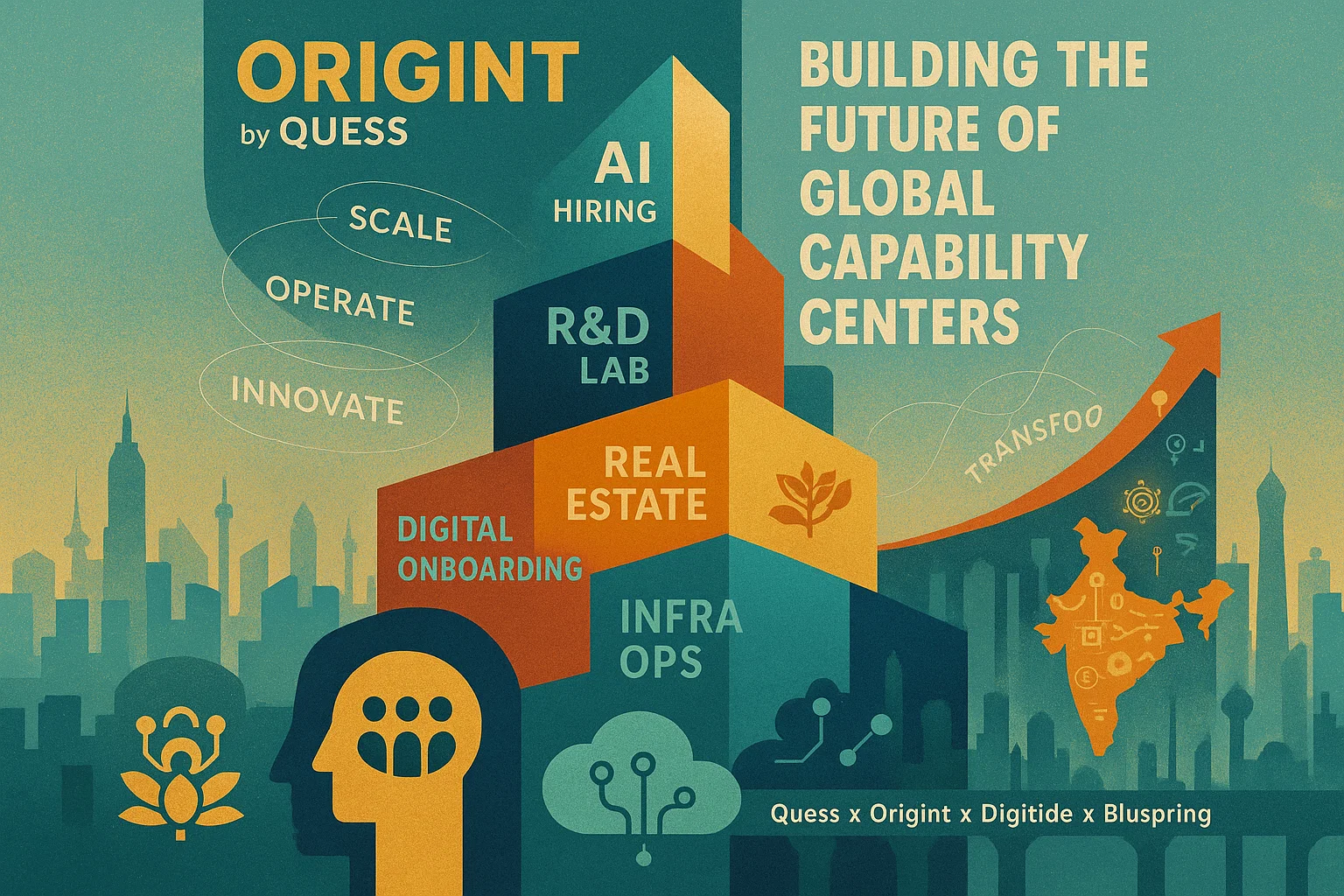
    Quess Corp, a staffing and workforce solutions company, has recently announced a strategic business line capitalising on the surging Global Capability Center (GCC) ecosystem with the launch of Origint. 

    This is an end-to-end service-line to help global enterprises set up, scale, and operate high-performing capability centers across India and key international markets.

    This strategic move comes at a time when India has emerged as the epicenter of GCC growth. The country now hosts over 1,700 GCCs, with 120 new centers launched in 2024 alone. These centers contributed to 17% year-on-year tech workforce growth, adding nearly 1.8 lakh jobs in 2024, and the market is projected to reach US$105 billion by 2030, employing 24 lakh professionals, a press statement said.

    As GCCs evolve from cost-efficiency centers into strategic hubs of innovation, Origint serves as a single-window solution to empower global capabilities and offers a comprehensive solution that spans blueprinting, regulatory compliance, real estate, infrastructure management, digital on-boarding, AI-powered hiring, and managed operations for global enterprises. It offers bespoke solutions for firms seeking shared service hubs, tech delivery centers, R&D units, or customer experience operations.

    “Global enterprises are increasingly seeking more than mere cost savings — they want speed, innovation, and efficiency at scale,” said Guruprasad Srinivasan, CEO & Executive Director, Quess Corp.

    “With Mohit Mathur joining as Chief Business Officer for our GCC business, we are scaling up this opportunity. Under Mohit’s leadership, Origint is being launched to transform capability centers into dynamic ecosystems that empower businesses to scale and thrive in a rapidly evolving digital landscape. This is more than a new service line, it’s a growth engine for our clients and for Quess. Origint is our commitment to powering the next wave of enterprise transformation, not as a service provider, but as a long-term growth partner.”

    “Over the last 17 years, Quess has built a solid foundation which further enabled us to support over 350 GCCs across 8 countries. Origint – Powered by Quess and in partnership with our demerged entities – Digitide for AI- first digital solutions and Bluspring for infrastructure management, and other key external global partners, we are making a bold bet on the future of GCCs. With this holistic approach across people, platforms, and precision delivery, we are poised to reimagine the GCC playbook.” said Lohit Bhatia, President – Workforce Management, Quess Corp.

    With a presence across 28 Indian cities and 7 global markets, Quess brings deep regional execution capabilities, a critical advantage for firms looking to scale in India and beyond. The company has already accelerated the growth journey for several enterprises across industries such as IT, BFSI, Engineering, Telecom, Manufacturing, and Retail through its capability center models. Through Origint, Quess Corp signals a larger ambition, to become the go-to partner for future-ready infrastructure.

  • Dai-ichi Life and Capgemini Sign Multi-Year Deal to Launch a GCC in India

    Dai-ichi Life and Capgemini Sign Multi-Year Deal to Launch a GCC in India

    French IT services and consulting firm, Capgemini, has signed a multi-year agreement with Dai-ichi Life Holdings, Inc. to establish a Global Capability Centre (GCC) in India. The new centre will be pivotal in driving the digital transformation of the Dai-ichi Life Group across its global operations.

    The GCC aims to leverage India’s highly skilled professionals to advance Dai-ichi Life’s IT and digital strategy. This initiative will enable the group to strengthen its in-house technology platforms and drive efficiency on a global scale.

    Through this collaboration, Dai-ichi Life will utilise Capgemini’s extensive digital capabilities. The centre will focus on advanced software development, infrastructure modernisation, artificial intelligence (AI), data solutions, and robust cybersecurity measures. This strategic move will provide the group with the flexibility to expand into other countries, aligning with its global growth ambitions and provide customers an enhanced experience.

    “This strategic partnership with Capgemini supports our long-term ambition to build differentiated, internal capabilities through the establishment of our Global Capability Centre,” said Tetsuya Kikuta, President and CEO at Dai-ichi Life Holdings in a press release.

    Aiman Ezzat, Chief Executive Officer at Capgemini, commented on the agreement, stating, “By combining Dai-ichi Life’s deep industry knowledge with Capgemini’s global business and technology transformation expertise, including our proven ability to deliver complex solutions, our partnership will help unlock new value for the Dai-ichi Life Group and its customers.”

  • First Citizens BancShares Expands Global Capability Centre in India

    First Citizens BancShares Expands Global Capability Centre in India

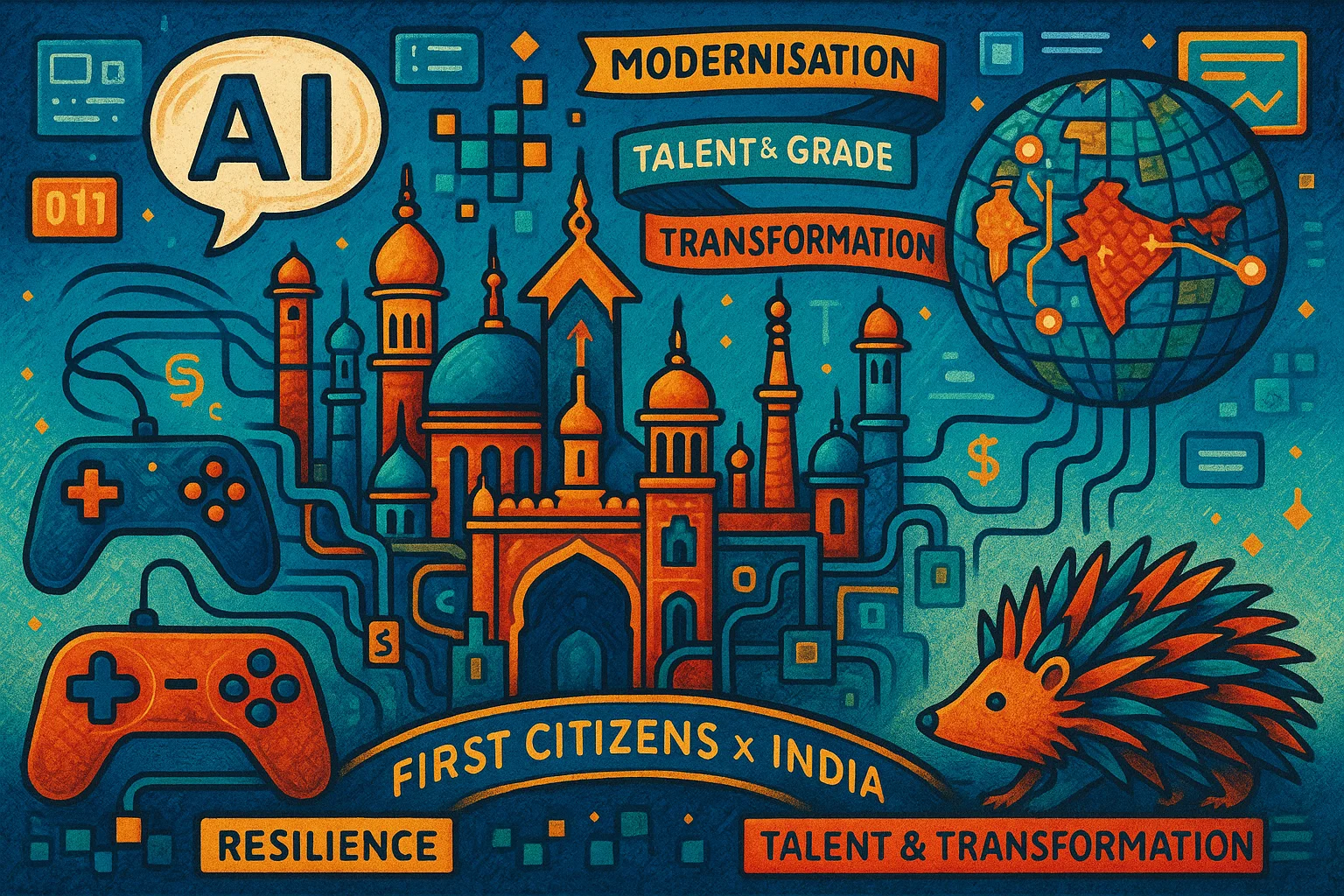
    First Citizens BancShares, Inc., one of the top 20 financial institutions in the United States   with over US$200 billion in assets, has deepened its investment in India by expanding its Global Capability Centre (GCC) in Bengaluru.

    The new office reinforces India’s role as a premier hub for GCCs delivering enterprise-wide solutions. The expanded facility supports core areas including Technology, Enterprise Operations, Finance, Cybersecurity, Risk Management, and Credit Administration.

    The key highlights of this expansion include the new office’s advanced, digitally-enabled work environment that fosters cross-functional collaboration, continuous learning, and career development. Bengaluru was strategically chosen for its vast talent pool, enabling First Citizens to tap into India’s strategic importance in the global economy. This expansion underscores the bank’s commitment to supporting the ambitions of its clients, colleagues, and communities.

    According to Jeff Ward, Chief Strategy Officer, First Citizens Bank, “Our decision to expand our footprint in the established hub of Bengaluru allows us to strategically leverage the country’s vast talent pool and directly support the long-term commitment to our enterprise vision.” 

    Satya Prakash Ranjan, Country Head & Head of Technology, First Citizens India, added, “As we continue to modernise and scale the bank’s technology platforms, this facility and our local team give us the flexibility and environment needed to deliver enterprise-grade solutions across a variety of functions.”

    The expansion is part of the bank’s continued investment in digital transformation, operational resilience, and building talent to meet evolving client needs. With this move, First Citizens aims to build lasting financial security for its key stakeholders.

  • Beyond Cost & Headcount: How Mid-Market GCCs Are Stepping Into Driver’s Seat

    Beyond Cost & Headcount: How Mid-Market GCCs Are Stepping Into Driver’s Seat

    The most interesting transformation in India’s Global Capability Center (GCC) landscape today isn’t being driven by the usual Fortune 500 suspects. It’s mid-market firms – agile, ambitious, and increasingly global in mindset – that are steering the next wave.

    What’s equally, if not more striking is this: nearly 45% of the country’s 1,760 GCCs are now run by mid-market firms – companies with revenues between US$100 million and US$5 billion, according to a report by ANSR.

    According to data from Everest Group, these centers collectively employ 220,000 professionals, and over 120 new ones are expected to spring up by next year.

    This isn’t just another footnote in India’s GCC story. It’s a shift in power.

    For decades, India’s GCC landscape has been led by multinationals, global banks, tech companies, and consumer brands. They first used India as a base for back-office work, and later for digital transformation and R&D. But what we’re witnessing now is a recalibration. Mid-tier companies are no longer just “scaling” their India operations, they’re designing their entire competitive strategies around it. 

    The Shape of the Mid-Market Surge

    Zinnov estimates that 35% of all new GCC activity in India in the last five years is from the mid-market GCC players. The revenue figures echo this momentum. As per Everest Group, these centers are expected to grow from US$6.5 billion in 2024 to between US$7.5 and US$7.8 billion by 2026, reflecting a strong 15–20% growth trajectory in just two years.

    Unlike their larger peers, mid-market GCCs aren’t weighed down by scale. Many operate like internal start-ups, agile, focused, and deeply embedded in their parent firms’ product and innovation engines. Zinnov notes that they’re 1.3x more likely to function as digital innovation hubs and are responsible for driving over 60% of enterprise product and platform portfolios.

    According to a recent PwC report, there has been a surge in Neo Banks and Mid-sized Banks, also increasingly opening GCCs in India, with the neo-banking market projected to reach a value of US$395 billion by 2026, a value of US$395 billion by 2026, a huge jump from US$19 billion in 2018.

    The India Advantage – Still a Winning Formula

    So, what’s fuelling this growth? According to a report by Inductus GCC, India’s enduring advantages continue to be a major draw, an expansive tech talent pool of 5 million professionals, over 1 million engineering graduates every year, and operating costs that are 25%–30% lower in Tier I and Tier II cities. But mid-market firms are also tapping into newer advantages: a maturing start-up ecosystem, academia partnerships, and state-level incentives like Karnataka’s tax breaks and expedited regulatory approvals.

    Models like COPO – Company Owned, Partner Operated – are also helping these firms scale efficiently. As noted by Inductus GCC, this model lets mid-sized firms operate lean while staying in control of operations and IP, avoiding the heavier capex associated with wholly owned subsidiaries.

    Innovation at the Core

    Mid-market GCCs aren’t just competing on cost, they’re setting the pace on innovation. According to Zinnov, many of these centers are accelerating internal leadership development pipelines up to 20% faster than their larger peers, while doubling down on high-impact domains like AI/ML, cloud computing, cybersecurity, and health analytics.

    An SEO analyst at Inductus recently highlighted several mid-market GCCs driving innovation in India. FactSet Research Systems, for instance, runs a Hyderabad-based GCC that plays a pivotal role in financial analytics and technology innovation. In Bangalore, IQVIA is leading the charge in AI-driven health insights that inform critical global decisions. Fintech firm Broadridge operates out of both Bangalore and Hyderabad, driving digital transformation across capital markets. And in Pune, Envista Holdings manages engineering operations for dental and life sciences, underscoring both the sectoral diversity and strategic depth of mid-market GCCs in India.

    The Giants Are Watching

    It’s not that the large players are slowing down, 70% of Fortune 500 companies are expected to expand their GCCs in India by 2030, according to a report by Nasscom and Zinnov titled ‘India GCC Landscape Report: The 5-year Journey’. But what’s changing is the degree to which mid-market companies are able to compete for the same talent, build similar capabilities, and even outpace the bigger firms in specific niche areas.

    As Sindhu Gangadharan, Chairperson of NASSCOM, puts it, “GCCs have rapidly evolved from being operational hubs to becoming true engines of innovation and strategic growth.” That evolution is no longer limited to the usual suspects. It now includes hundreds of ambitious, mid-sized global companies that see India not just as a support function, but as central to their future.

    Challenges Remain, But So Does the Momentum

    Of course, it’s not without hurdles. Mid-market GCCs face stiff competition from deep-pocketed MNCs for talent and real estate. Global macroeconomic uncertainties–tariffs, geopolitical tensions, regulatory shifts–can disproportionately impact firms with thinner buffers.

    But what they lack in scale, they make up for in speed. Their ability to experiment, pivot, and build fast has kept them resilient. And increasingly, they’re building Centres of Excellence (CoEs) in fields where rapid innovation cycles are critical, think fintech, digital health, and supply chain analytics.

    Looking Ahead

    According to the Nasscom and Zinnov report, by 2030, India’s total GCC count is expected to reach 2,100–2,200, with combined revenues of US$99–US$105 billion and a workforce of up to 2.8 million. Of this, a significant share will come from the mid-market. These firms are no longer in the shadows of the multinationals, they’re standing shoulder to shoulder, competing not just on cost, but on capability and vision.

    In many ways, India has become the ultimate test market for global ambition. And mid-market GCCs, once the underdogs, are now emerging as its most dynamic contenders.

    Game on.

  • Episode 10: Navigating Talent Gaps, Retention Hurdles and AI Innovation

    In this episode of The GCC Hub Podcast, we explore the latest trends shaping the future of Global Capability Centres in India. From talent retention challenges to the emergence of Agentic AI in the BFSI sector, we unpack the top stories in the industry.

    Key Takeaways:

    • GCCs struggle to retain talent, as 52% of employees are exploring new opportunities.
    • India, the US, and Mexico lead GCC ecosystems, with India standing out for its unique combination of scale, innovation, and efficiency.
    • Deutsche Bank’s appointment of Stefan Schaffer as CEO of its India operations highlights its strategic focus on India as a global tech and innovation hub.
    • Agentic AI is emerging as a game-changer in the BFSI sector due to its real-time decision-making capabilities.

            Tune in Now!

  • AstraZeneca India Outlines Strategy for Talent-Led Growth in GCCs

    AstraZeneca India Outlines Strategy for Talent-Led Growth in GCCs

    Pharmaceutical major AstraZeneca India is revolutionising its approach to talent management in Global Capability Centres (GCCs) by implementing a strategic framework that prioritises skill-based growth, inclusivity, and technology-driven HR processes. 

    According to Anuradha Kumar, Head of HR, GITC, AstraZeneca India, who was speaking at the People Matters GCC Talent Summit 2025 in Hyderabad, this shift is about reimagining HR as a catalyst for competitive advantage, where talent strategies are intricately linked with business objectives. By adopting digital talent scouts, the organisation proactively identifies and develops critical skill sets, reducing hiring lead times and staying ahead in the competitive market.

    This forward-thinking approach enables AstraZeneca to build long-term capabilities, with about 10% of annual hires being graduates from top institutions developed for future readiness rather than immediate role fit. Technology plays a pivotal role in enhancing hiring efficiency, candidate experience, and recruiter capacity through automation and AI, ensuring consistency and minimising bias. 

    Moreover, AstraZeneca fosters an inclusive culture, prioritising gender diversity, early-career professionals, the LGBTQIA+ community, and neurodiverse individuals, creating psychologically safe environments through Employee Resource Groups (ERGs) and leadership-level advocacy.

    The implications of AstraZeneca’s strategy for GCCs suggest that organisations must make deliberate shifts to embed skill-based thinking, utilise technology purposefully, design for inclusion, and enable talent to grow with the business. 

    By adopting these strategies, GCCs can transcend mere hiring and focus on nurturing, aligning, and retaining talent, ultimately driving sustainable growth and competitiveness. As industry experts note, this talent-driven approach will be crucial for GCCs to evolve into innovation hubs, contributing significantly to enterprise decision-making and global growth.

    According to People Matters, AstraZeneca’s experience offers valuable insights for GCCs aiming to build future-ready organisations. By rethinking talent strategies and leveraging technology, GCCs can unlock the full potential of their workforce, driving business impact and sustained growth. This approach not only enhances talent density and agility but also empowers organisations to adapt to the rapidly evolving business landscape.

  • GCCs in BFSI: Why Agentic AI Trumps Generative AI

    GCCs in BFSI: Why Agentic AI Trumps Generative AI

    The financial industry is undergoing a significant transformation, driven primarily by advancements in artificial intelligence (AI). While Generative AI has garnered attention for its ability to create content, summarise reports, and personalise customer interactions, Agentic AI is emerging as a game-changer in the Banking, Financial Services, and Insurance (BFSI) sector.

    The key distinction between Generative AI and Agentic AI lies in their functionality. Generative AI focuses on producing outputs based on inputs, whereas Agentic AI is designed to take autonomous actions, make complex decisions, and drive real-time financial processes. In an industry where precision, compliance, and risk management are paramount, the ability of Agentic AI to act decisively and autonomously makes it an indispensable tool.

    Agentic AI is a major disruptor for BFSI GCCs due to its real-time decision-making capabilities, allowing GCCs to respond swiftly to market fluctuations and regulatory changes. This is achieved through features like fraud identification, trade placement, risk management, and compliance.

    The BFSI sector requires real-time decision-making, particularly in areas such as fraud prevention, trading, and compliance. Agentic AI’s ability to autonomously execute decisions makes it better suited to meet these demands. In high-frequency trading, Agentic AI can continuously monitor market fluctuations, predict stock trends, and execute trades based on real-time data. Similarly, in compliance and regulatory automation, Agentic AI can enforce policies automatically, minimising human error and ensuring adherence to changing regulations.

    While Generative AI can enhance customer engagement and efficiency, Agentic AI drives action, prevents fraud, optimises trading, and ensures compliance. By combining both types of AI, financial institutions can create a seamless banking experience. For example, an AI-driven financial assistant powered by both Generative AI and Agentic AI can summarise spending habits and adjust credit limits automatically based on spending patterns.

    Unlike Generative AI, which generates insights and reports, Agentic AI takes preventive action, minimising human error and ensuring adherence to changing regulations. This autonomy enables Agentic AI to automate complex workflows, freeing up human resources for high-value tasks like financial advisory and relationship management.

    The benefits of Agentic AI for BFSI GCCs are multifaceted. It improves risk management by autonomously identifying potential market disruptions or regulatory changes and adjusting exposure accordingly. Agentic AI also optimises customer service, offering tailored financial advice, automated portfolio management, and fraud detection systems that continuously learn and adapt. Additionally, automation can increase workforce productivity by up to 40%, enabling GCCs to reallocate human resources toward high-value tasks.

    Early adopters of Agentic AI can expect a 22-30% potential increase in efficiency and effectiveness. To stay ahead, BFSI GCCs must invest in Agentic AI and develop a robust data foundation to support its deployment. However, there are key challenges to consider, such as ensuring data readiness and governance, acquiring the right talent, managing change, and integrating Agentic AI with existing technology investments.

    Agentic AI’s capabilities extend far beyond content creation. It can identify fraud, place trades, manage risk, and drive compliance in real-time, making it a vital component of modern financial institutions. For instance, Agentic AI can automatically monitor and respond to fraudulent activities, freezing transactions and alerting customers without human intervention. In contrast, Generative AI might generate a fraud analysis report but cannot take preventive action.

    By adopting Agentic AI, BFSI GCCs in India can drive innovation, efficiency, and growth, staying ahead of the curve in a highly regulated financial landscape.